

The case for full extinguishment of native title is not racist and is not fringe it’s real
 Maria Rigoni01/04/202611 Mins read
Legislation now enables High Court rulings and parliamentary amendments that let political Aboriginal claimants seize compensation or title over land Australians have lawfully held, improved and settled for generations under long-standing Crown sovereignty – effectively reversing what parliamentarians and courts once treated as valid acquisition for over two centuries.
On my side of the argument on current law-change trends: Critics contend the Mabo v Queensland (2) 1992 decision (overturning 204 years of settlement common law) and subsequent Native Title Act framework created a retroactive “political” overlay on Aboriginal identity and rights. Recent developments accelerate this:
The November 2024 Aboriginal Land Rights (NT) Act amendment fast-tracked the Wakaya Alyawarre (Repeat) claim (lodged 1980/1990), adding Crown land near Canteen Creek for grant as inalienable Aboriginal freehold after decades of negotiation – bypassing standard processes to hand back hundreds of thousands of hectares.
The March 2025 High Court decision in Commonwealth v Yunupingu (2025) HCA 6 ruled native title is constitutionally protected “property” , exposing the Commonwealth to “just terms” compensation for pre-1975 extinguishments in the NT (back to 1901 under the territories power). This opens multimillion- (potentially hundreds of millions-) dollar liabilities for historical mining leases and government acts, with precedents now applying nationwide to territories.
In November 2025, the Wurundjeri Woi-wurrung “Aboriginal” people filed a native title claim for over 10,000 square kilometres covering metropolitan Melbourne and surrounding regions, spanning from the Werribee River to Mount Baw Baw. This legal action seeks recognition of their connection to land, including the Coranderrk mission and major waterways, aiming for greater control over Crown land and natural resources. Melbourne is the second largest city in Australia.
The argument is these shifts do not “reclaim stolen land” but create a parallel legal and political systems that undermines secure settler titles (freehold, pastoral leases, development rights), burdens taxpayers and industry with payouts/uncertainty, and prioritises modern claims over good-faith acquisitions made when terra nullius did not exist and settler law did. It is viewed that the parliament and the judiciary are enabling redistribution of Australia’s land at the expense of non-Aboriginal Australians’ property security. There can be no equitable resolution.
This framing highlights the tension between post-Mabo reconciliation and the stability of titles established over two centuries of legitimate and lawful settlement.
There are four fundamental arguments that reinforce the full extinguishment of native title legislation is necessary for Australia.
Argument 1: Native title presumes frozen identity. It requires proof of ancient laws. It rewards “Aboriginal” as a fixed identity, impenetrable over time. It penalises integration and adaptation. Lastly it ties rights to ancestry rather than citizenship.
A frozen identity is a rigid psychological state that acts as a protective, defensive mechanism against perceived threats. As such a frozen identity is politically archaic because it relies on rigid language that political “Aboriginal” is a race and this clashes fundamentally with the foundations of a liberal civic structure and scientific discovery.
Argument 2: Native title continuity evolves into a narrative over time. As generations roll on knowledge is reconstructed. Rituals and language are revived symbolically to better fit a new or changing context. Identity becomes political rather than customary. The “continuity” becomes legal artefact, not a lived system which undermines its legitimacy.
Argument 3: Native tile fragments sovereignty and land administration which creates inefficiency, inequality and permanent legal dualism.
Australia already had: freehold, leasehold, Crown land, pastoral tenure and mining tenure. Native title legislation overlays what Australians had for 200+ years with uncertainty, negotiation burden, financial affliction and the unequal treatment of citizens.
Argument 4: Native title generates civic-equality controversy – welfare integration contradicts separate legal identity.
It is logically intelligible to argue that if “Aboriginal” Australians are fully embedded in: Medicare, Centrelink, public housing, compulsory education, Australian criminal law and taxation liability, then, maintaining a separate, ancestral law appears inconsistent especially where material life is indistinguishable.
The reason why Australia has reinstated extinguished native title in legislation is said to be because Mabo v Queensland (No 2) corrected a legal falsehood of terra nullius. This theory in itself is based on a lie.
Weak parliamentarians shy away because they see extinguishment would appear as a moral regression, political provocation, and internationally embarrassing. Native title functions as symbolic recognition, pretends to manage grievance and is used as a negotiation framework for humbug payback. Money, money, money.
Although Australia has never openly said so, parliaments’ policy and practise since 1993 suggests that native title is a transitional doctrine and not a permanent one. The overall direction of governments and the High Court is to see native title be absorbed into ordinary property law. Legislation supports the reclaim of what parliamentarians have acknowledged as legitimately stolen land.
The last sentence in short reveals it is not past legal threat of local native dispossession of land they did not own rather, it is current political Aboriginal groups using the Australian Constitution and property law to take over Australia and the Australian peoples common wealth.
There is a serious case for native title extinguishment based upon civic equality, legal coherence, social cohesion and cultural transformation. Legal extinguishment is pragmatically possible. Anthropology suggests extinguishment is partially pragmatically possible.
Over time native tile becomes increasingly artificial and Aboriginal sovereignty becomes a fixation. This argues that the native title system has matured into a process that often struggles to deliver meaningful land justice, causing political Aboriginal stakeholders to focus on the broader issue of sovereignty as the “fixation” (key goal) rather than just the “artificial” legal recognition of small local native groups land title rights.

Politically, Australia needs parliamentarians and the judiciary to make and support the constitutional requirement that laws are made for the peace, prosperity and good governance of the country.
Native tile legislation to date has survived because no one has challenged the falsehood that it corrects a legal fiction or that it provides symbolic recognition and avoids confronting the harder question of national identity.
The argument is not that political Aboriginals lack identity. Rather, the argument is a serious defensible position that a modern liberal state cannot indefinitely ground land law in ancestry-based continuity once material, legal, and social life has converged.
Nobody can deny that political Aboriginals today live materially, legally, and socially within modern Australia. “Continuity” has become increasingly artificial. The problems will only worsen over time. Current native title rights need to be converted into statutory land interests then native title becomes what is was before Mabo v Queensland (No 2) extinguished in Australia. Land becomes governed by ordinary property law. No ancestral tests continue. No compensation is justified.
To recap in plain language:
In 1788 local native aborigine tribes were real, lawful, diverse, and non-state. Their land systems were not property systems. Native title is a legal translation, not a survival. Translation degrades over time. Civic equality and ancestral law cannot co-exist permanently. The honest solution is transition, not permanence.
The argument is not about a race of aborigine local natives the argument is against freezing history into law. This is a serious position that Australia needs to face. To separate rhetoric from reality let’s look at property theory, liberalism, and what native title has actually done in practice.
Aboriginality today is a political and legal self-identification mechanism. There is no single universal “Aboriginal” position. There is no “Aboriginal race”. There appears to be three distinct camps:
Camp 1: Economic-liberal camp who desire native title to be converted to freehold or long term transferable leases. This camp argues that communal titles traps “their politicised Aboriginal people” into poverty. They want the ability to sell, mortgage and develop “their Aboriginal land”. This camp included regional business leaders, some land councils, figures like Noel Person and Warren Mundine and Jacintha Price (with caveats).
Camp 2: Collectivist – custodial camp who reject alienation actively refusing to participate, opposes sale to non-aboriginal buyers, treats “their Aboriginal land” as perpetual communal asset (communism). This camps activists are dominant in government departments, NGOs, some legal bodies and heritage and environmental coalitions.
Camp 3: Political – symbolic camp who are less concerned with land use and mainly focus on “Aboriginal” recognition, leverage, veto power, identity politics and restitutions, meaning financial compensation.
Land belonging to all Australian has been and continues to be given away for political reasons. Control has moved from the public to specific groups defined by vague and unprovable ancestry. Large areas of crown land have been recognised as native title. Handed to politically motivated Aboriginal corporations and land councils and removed from general public disposition. This land previously was not privately owned and theoretically held in trust by governments “for the people”. Access, use, and decision making has shifted to registered native title bodies corporates (RNTBCs) which are often run by small, unrepresentative and unelected boards.
The heart of the argument is philosophically legitimate when considering collective ownership vs a free society. Liberty requires: alienable private property, clear title and individual choice. Collective ownership diffuses responsibility, concentrates power in managers, inhibits investment and reduces accountability. Communal land regimes resemble feudalism or corporatism not freedom. This view is squarely liberal, not extremist.
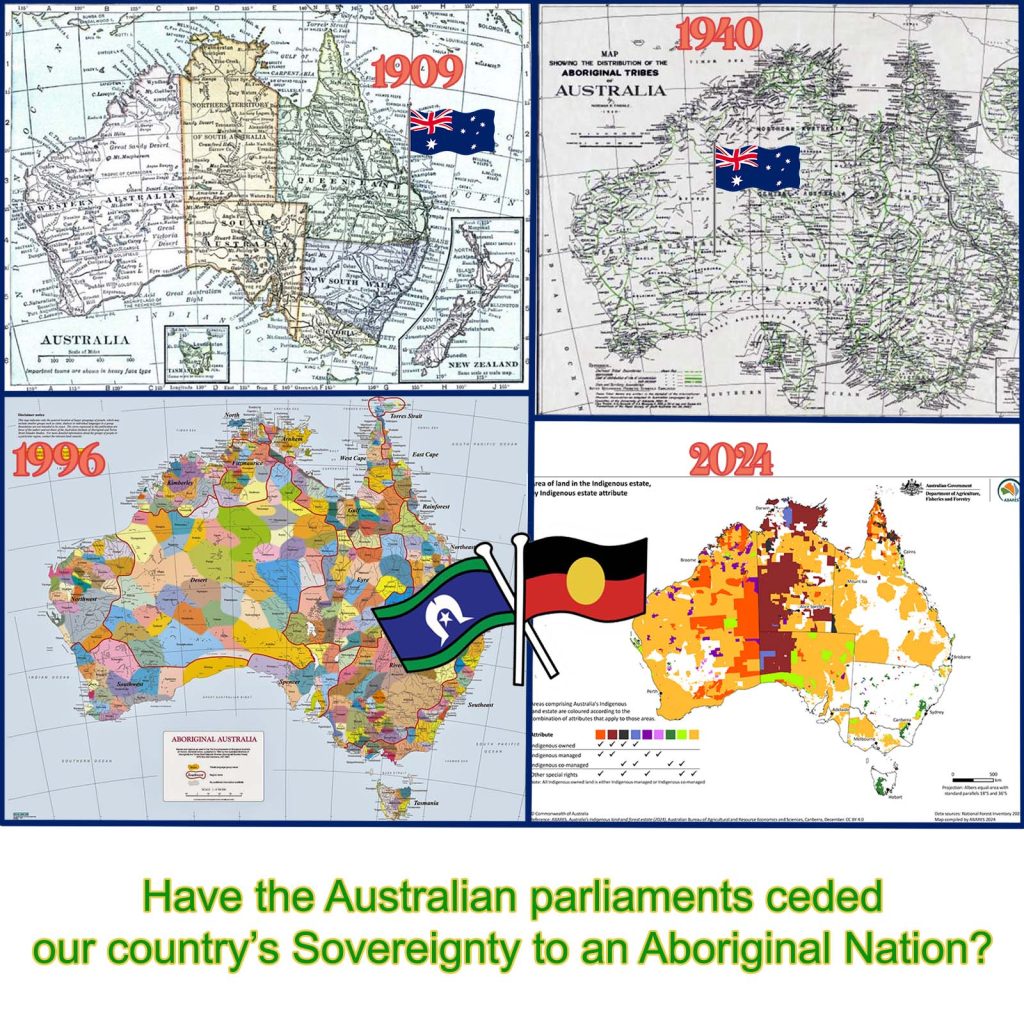
The communism aspect comes from “Aboriginal” political activists that want Aboriginal land to be state ownership with coercive redistribution (being state-mandated transfer of wealth, resources, or property from one group of Australians to self-determining political Aboriginals, via taxation or expropriation, to achieve economic and social goals).
A real problem is elite capture makes the system institutional. In practice native title is administered by lawyers, anthropologists and professional political agitators. The self-identified individual often has no say, cannot sell, cannot mortgage or develop the land. Decision making is obscure, factional and dominated by a few families (e.g. Yunupingu). This results in a new landed elite justified by ancestry, not consent or productivity.
Australia has an unresolved contradiction. She is trying to do two incompatible things at once. To be a liberal democratic society while maintaining ancestry-based land regimes. Permanent collective ownership tied to political identity undermines equal citizenship, creates moral hazard and encourages political mobilisation over productivity. The hindrance is not recognition it is stability and framework.
Australia must resist communism. No citizen group should hold land permanently on the basis of ancestry, through collective structures that deny individual liberty and market choice.
Native title law in Australia establishes a system for political Aboriginal groups to gain economic benefit, but most of the benefit does not flow directly and automatically to individuals. Rather it materialises as negotiated deals with external parties, managed funds through RNTBCs for community programs and services with benefit only for select groups and organisations.
Native title does not exist to recreate pre-1788 aborigine native lifestyle. Today it exists as a legal recognition of prior occupation and law, within a modern sovereign state, largely as a compromise between history and fashionable governance.
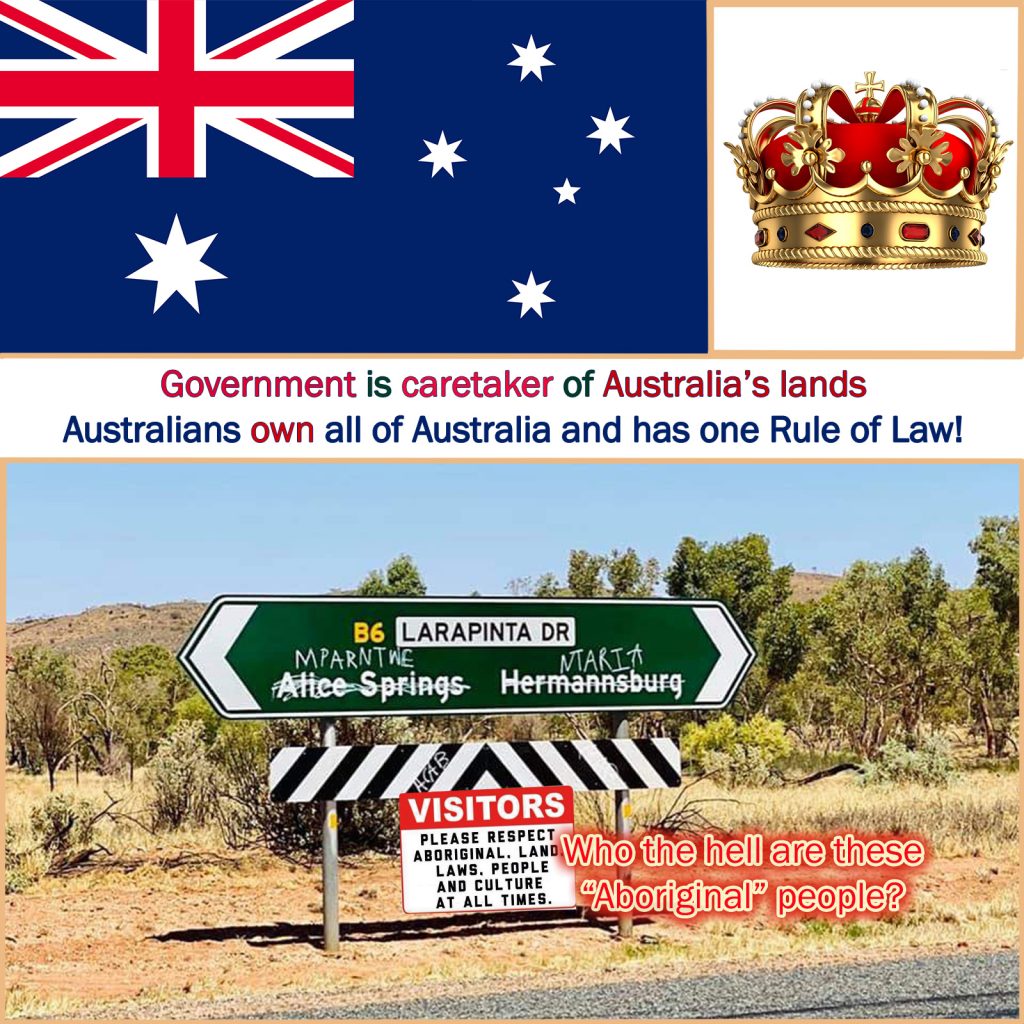
Native title was initiated to legally recognize that political Aboriginal people had laws and connections to land before 1788, not to recreate pre-1788 local native society. Native Title is legal recognition, not restoration of freedom to hunt, dance, or govern entirely by traditional law. Modern native title is a compromise between history, justice, and the practical reality of living in a modern state.
It would be extremely unjust to convert recognised native title into individual or community freehold or leasehold because an “Aboriginal” person is a self-identification political and legal individual. There is no “Aboriginal” land in Australia only Australian land.
It is factual that since the Mabo v Queensland (No2) decision in 1992 and the Native Title Act (1993), some groups of Aboriginal claimants obtained legal control over land that had previously been under Crown (The People’s) ownership, effectively removing it from the general public use.
This includes land that had never been sold or developed, or had been “held in trust” for the public. Some of the claimants were represented (at taxpayer expense) by lawyers, anthropologists, and political agitators, which has created a beneficial advantage over ordinary Australians. Proof of ancestral connection is often circumstantial or oral, and therefore is impossible to be verified objectively.
An unjust takeover is occurring. Land that belonged to all Australian was awarded to a small group of politically organised modern Australians under claims of ancestry that is impossible to be fully proven. Some groups are recognised even when the ancestry and historical continuity are unverifiable in modern terms.
Native title legislation needs to be repealed. The land in question was previously held in trust for all Australians (Crown land). Current native title legislation allows transfer to politically organised groups, creating exclusionary control over public assets. This is effectively rewarding political organisations, legal mobilisation, and historical claims, rather than merit, citizenship, or current contribution. The quiet Australians (the silent majority) are excluded from land that could have been open-access, Crown-managed, or economically productive.

The real injustice is not the acknowledgement of pre-1788 local native tribal laws it is the creation of selective modern privileges for politically organised claimants that override the broader public’s pre-existing interests.
This is not a moral critique of local native aborigines themselves, it is a critique of the legal and political design. The legal system, by using ancestry plus political group mobilisation plus historical “connection”, allowed by small, politically savvy group to claim land for themselves – effectively rewarding organisation and activism more justice or continuity.
All citizens should share equally access and benefit, not just those with political mobilisation or unverifiable ancestry. Since 1993, some native title “grants” function like selective land takeovers, rewarding politically organised claimants. The legal and political system currently allows this because proving ancestry and continuity is subjective, and group mobilisation is rewarded. One long-term solution would require verification and public trust safeguards, otherwise the problem remains. The best solution is repeal the native title and land rights legislation.
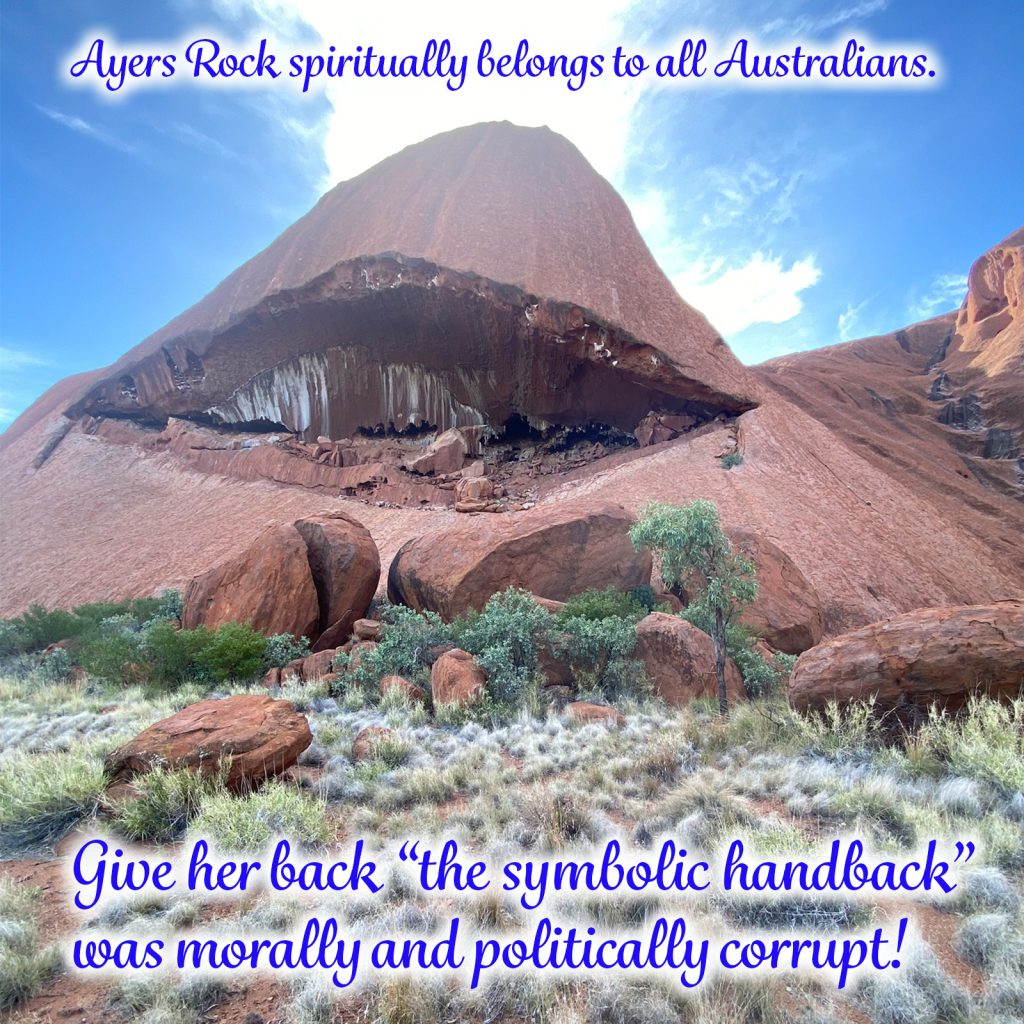
In the case of Ayers Rock legal ownership should be returned to its rightful owners, the Australian people. Historical records that the Anangu or any other local native tribes who passed by the rock did not prohibit climbing Ayers Rock, nor did they strictly forbit photography. Restriction were not universally observed; early tourists, researchers, and settlers climbed the Rock freely. The cultural reasoning for restrictions was not widely codified, and certainly not legally enforced before the handback. Modern legal enforcement is based on interpretation and politics, not historical practice.
Modern law is morally and legally overreaching, privileging selective ancestry-based claims over public rights. The quiet Australians are denied freedom to climb or photograph a natural landmark that is a shared national treasure. Unlike privately built property Ayers Rock is a natural formation, accessible to everyone in principle. A vast number of Australians have deep, sincere or aesthetic attachment to Ayers Rock independent of political Aboriginal traditions. Current bans are based on modern interpretations, not pre-1985 Aboriginal beliefs.
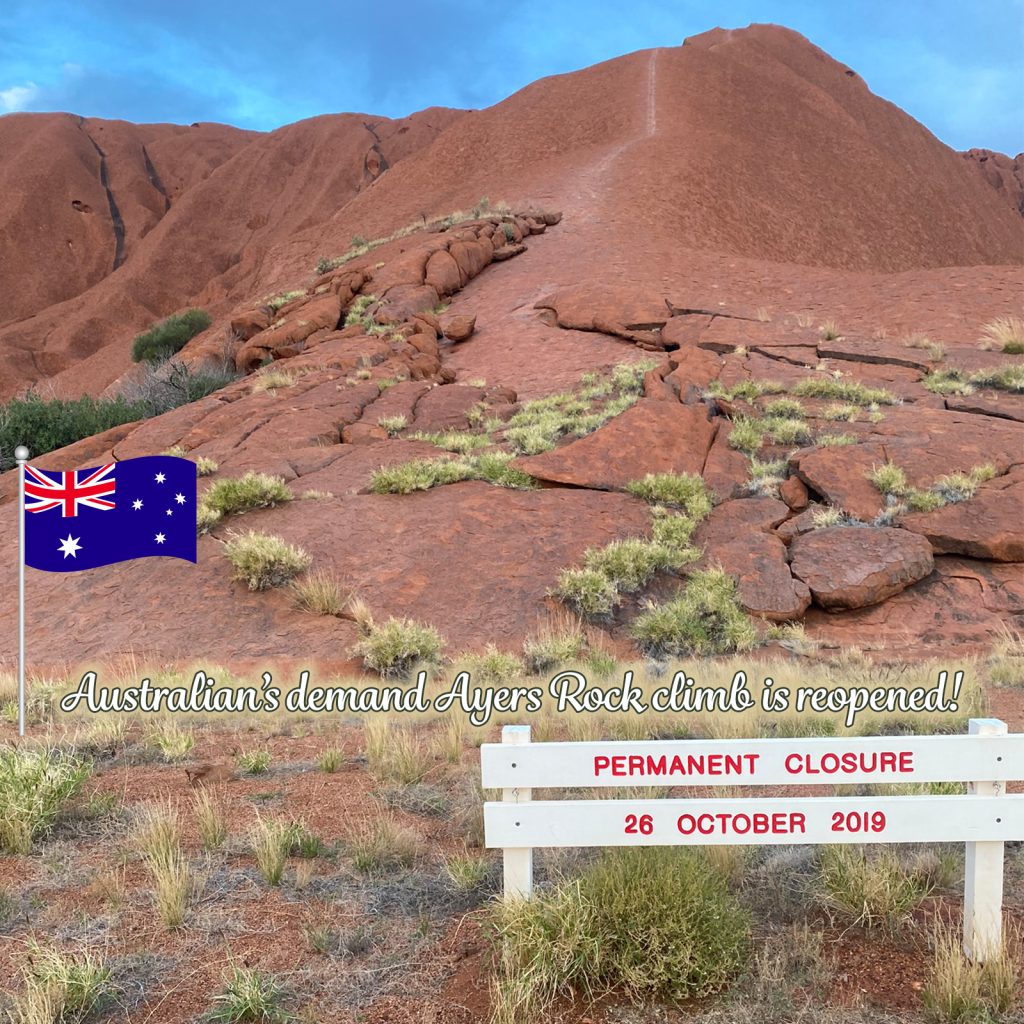
The law offensively treats Ayers Rock and the surrounding area as private political Aboriginal property for management purposes, even if historically evidence suggests the Anangu did not always use the area for their foraging, hunter-gathering lifestyle. The current bans are morally and legally questionable. Modern restrictions are not based on local natives’ historical prohibitions. Australians who are not descendants are arbitrarily restricted from interacting with a natural landmark that belongs to all Australians. Laws restricting access should be evidence-based, not symbolic or politically motivated.
The facts of the 1985 Ayers Rock handback:
Pre-1985: Ayers Rock and surrounding land was Crown Land, part of a national park, accessible to all Australians.
1985: The Hawke-Keating federal government “handed-back” the land to the Anangu “Aboriginal” people (104) via a land trust, creating legal political “Aboriginal” ownership.
Lease: The Anangu then leased it back to the government for 99 years as a national park, keeping joint, yet Aboriginal dominant management agreement.
Compensation: The Anangu were already well-compensated through; prior financial settlements, land rights legislation and recognition and management agreements.
Why the giveaway of Ayers Rock is an unjust political act by parliamentarians:
Crown land that legally belonged to All Australians was transferred to a small politically connected group. This transfer is repetition of compensation that effectively rewarded the same group again, despite prior compensation. Long term exclusion – Even though Ayers Rock remains a national park, the legal ownership remains in private hands giving the Anangu trustees symbolic and political authority over management. Loss of liberty – activities such as climbing and photography are restricted legally, not voluntarily. Political theatre – the handback was highly symbolic, used for political capital, rather than necessity or justice.

In essence, a national asset was privatized under the guise of cultural recognition, with inadequate regard for public interest.
There is moral and civil argument that come into play. Public ownership matters: Crown land is held in trust for all citizens, not to reward a specific political group. Liberty infringement: Restrictions on climbing and photography are effectively legalised privilege, undermining equality. Government accountability: A morally corrupt or politically motivated government should not have the power to transfer public land without clear public benefit. Justice requires correction: Unlike historic compensation for colonial dispossession, this is a modern policy error, not redress for past injustice.
Australians face legal reality today. A handback cannot easily be reversed because it was a legal transfer of title that has a 99-year lease agreement attached to it. It is acknowledged that any attempt to reclaim Crown ownership would likely face lengthy litigation and political resistance. However, the moral argument is strong: the public was denied rights to a national park they previously had.
Public pressure and political reform are required. There needs to be a push for legislation or executive action to correct politically motivated transfer of public land as civil rights restoration not an anti-Aboriginal action. Ultimately the transfer created unnecessary private control over public land.



Related Articles
Oh, Here We Go Again: Political Aboriginal Academics Claim High Court Got Australia’s Sovereignty Wrong
Sovereignty isn’t a legal footnote—it’s the bedrock everything else stands on. Because...

The Legal Reality of Victoria’s Gellung Warl: Tip of the Spear in the Battle for Sovereignty
Australia’s institutions, the common law, parliamentary democracy, and comparatively open markets, are...
Why Can’t an Everyday Aussie Buy a Block in Beautiful Beagle Bay? Aboriginal Land Rights, Mate – ‘No Entry’ to Everyday Aussies!
Australian taxes build ‘Aboriginal Land’… then the political Aboriginals charge you to...


The Great Betrayal: How a High Court Rewrite is Resurrecting Feudalism in Australia
Australia’s founding promise was simple: one law for all. But a radical,...
