History Never Leaves Maps Alone After You Invent One Aboriginal People With the Right to Choose Their Own Status
 Maria Rigoni22/09/202611 Mins read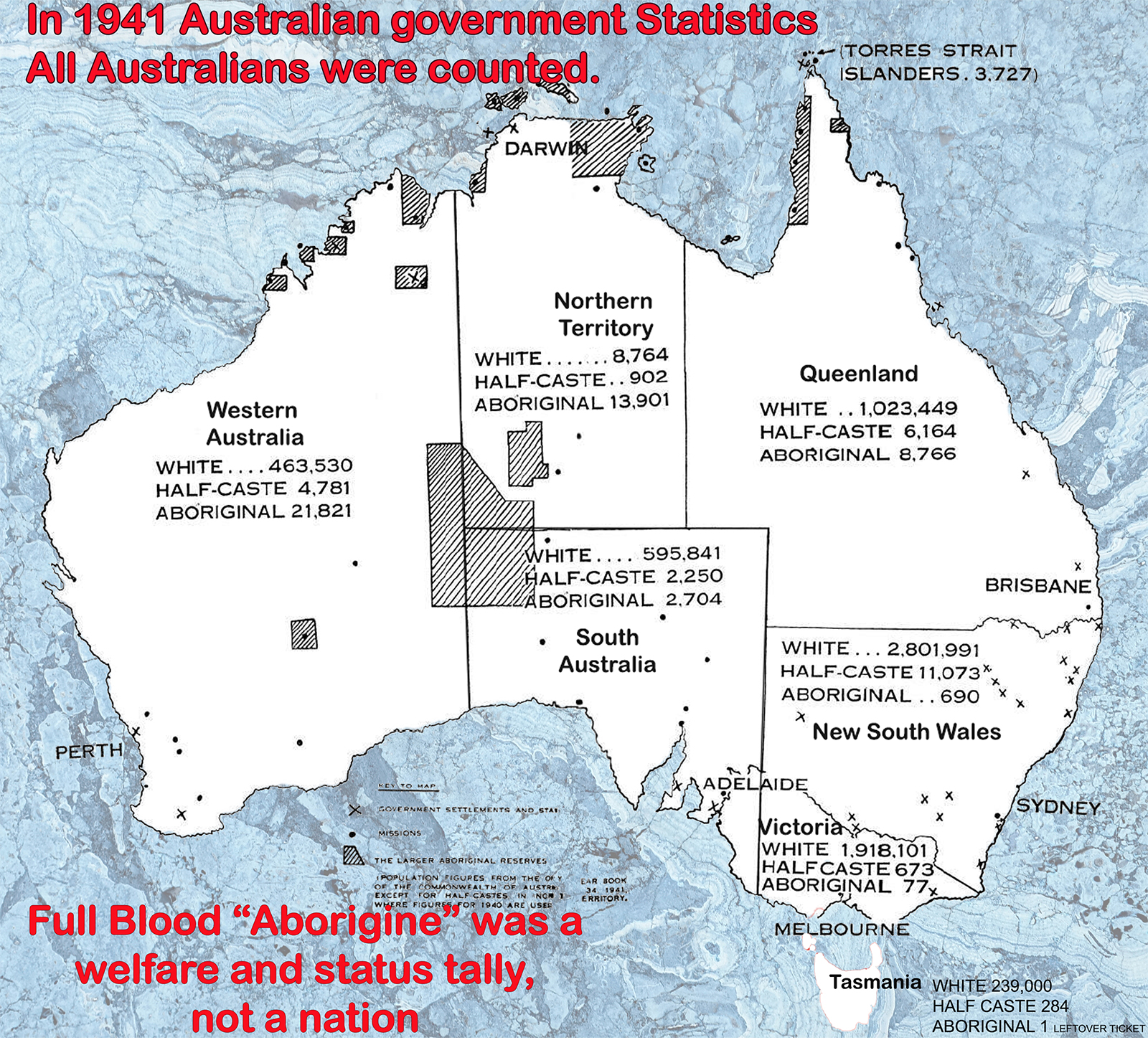
Has any Australian parliaments ceded our country’s sovereignty to an Aboriginal nation – or only passed laws that pretend the job is done?
You take hundreds of distinct groups, roll them into one political “Aboriginal people,” then hand that invention the United Nations human right to freely determine its own political status. History is not famous for leaving the map alone after that move — and Victoria’s treaty language now says the quiet part out loud.
UNDRIP – United Nations Declaration on the Rights of Indigenous Peoples
The John Howard Liberal Coalition government voted against UNDRIP in September 2007. The Kevin Rudd Labor government endorsed it on 3 April 2009. Jenny Macklin, member for Jagajaga, and then Minister for Indigenous Affairs, made the announcement and stressed it was non-binding and did not change existing Australian law.
UNDRIP is an UN speech from 13 September 2007. Not a treaty. Not a law. Australia voted no, then a later parliamentary mob “endorsed” it like they’d signed the visitors’ book at the Opera House and called it the title deed.
They dressed it up as “minimum standards” for survival, dignity and well-being. What it actually is, mate, is a catalogue of special claims — self-determination, land, language, the lot — sold as ordinary human rights so nobody has to say the quiet bit: one set of citizens, two sets of political status.
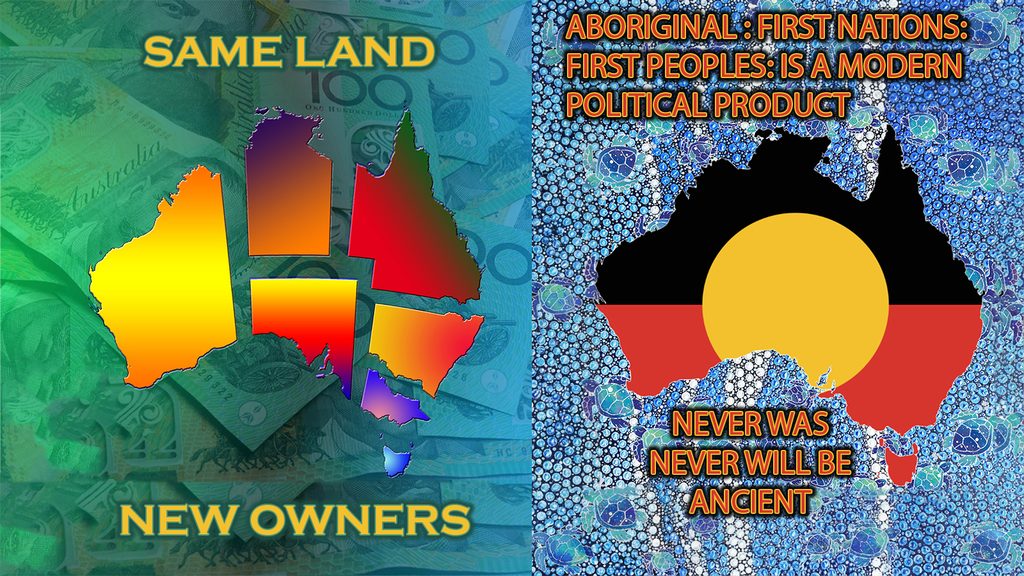
And here’s the con. It has no legal force in Australia. Jenny Macklin, back then, said so. Doesn’t matter. Weak political will sucked it up anyway. Soft paper, hard consequences. They wave a document that couldn’t convict a parking ticket, then use it to build treaties, assemblies and a parallel people with the right to choose their own status.
That’s not statesmanship. That’s not a knife. That’s a tourist brochure being treated like the Constitution — and Australia’s sovereignty is the thing getting carved.
UNDRIP Article 43 does say the rights in it are “the minimum standards for the survival, dignity and well-being of the indigenous peoples of the world.” The menu is real: self-determination, culture, language, health, education, land.
The con sits in the noun. UNDRIP never defines “Indigenous peoples.” That was deliberate. No legal test. No list. No map. The nearest working description is an old UN study, not the Declaration itself. Article 33 then lets the group decide its own identity and membership. So the rights attach to a people the document will not name, and the people get to name themselves.
In Australia that becomes one political “Aboriginal people” stitched together from hundreds of distinct groups, then handed a right to determine their own political status.
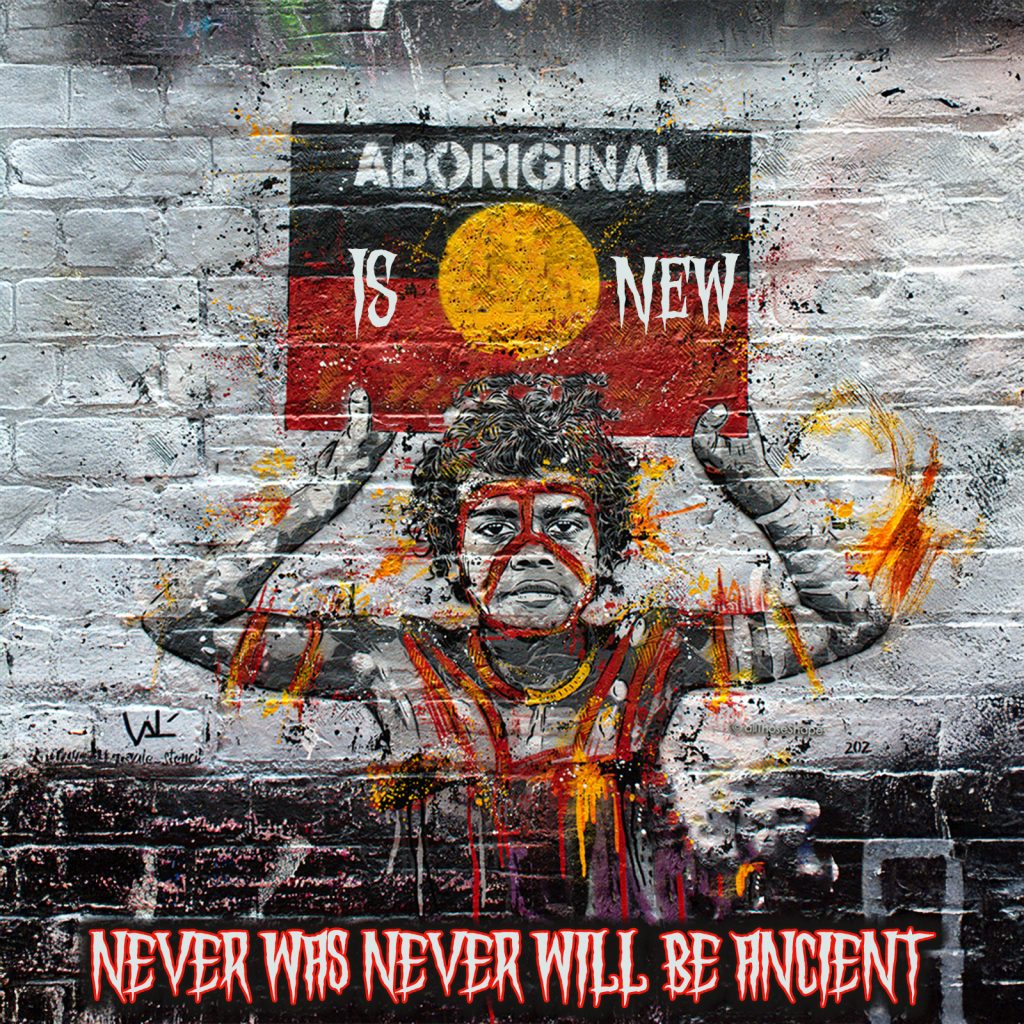
Repeat: UNDRIP has no legal force in Australia. That is the point of the con. You wave a non-binding document, quote it like scripture, then build treaties, assemblies and parallel status on top of it while insisting nothing has changed. Soft law with hard consequences. A framework that is “only a guide” until it is written into the machinery of the state.
UNDRIP is a solution looking for a problem that was never there. It isn’t a treaty. It isn’t Australian law. Nobody voted for it. It’s a United Nations declaration — a polite international memo. Australia voted against it in 2007, then “endorsed” it in 2009 like you endorse a mate’s new haircut: nice words, no contract. In this country a UN wish-list doesn’t sneak into the Constitution through the back door.
Article 3 is the bit they don’t read out at the sausage sizzle. It says indigenous peoples have the right to self-determination — they freely determine their political status and chase their own economic, social and cultural development. Article 4 adds self-government for internal affairs and a way to pay for it. That’s not “have a yarn with the local member.” That’s a second set of rules.
Article 46 is the “she’ll be right” clause. It says you’re not allowed to break up the country. So the pitch is: invent a second people with their own political status, plaster their map on the civic wallpaper, and trust us the borders stay put. Pull the other one.
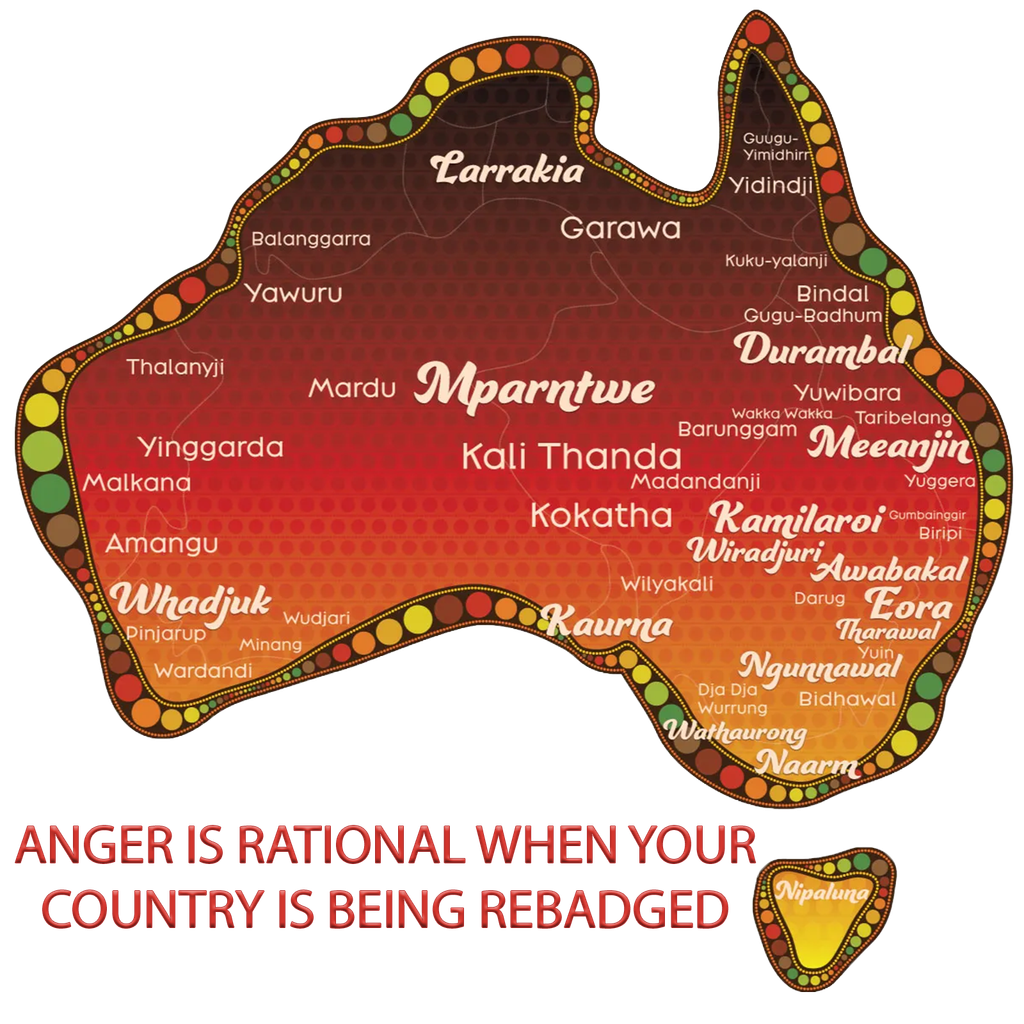
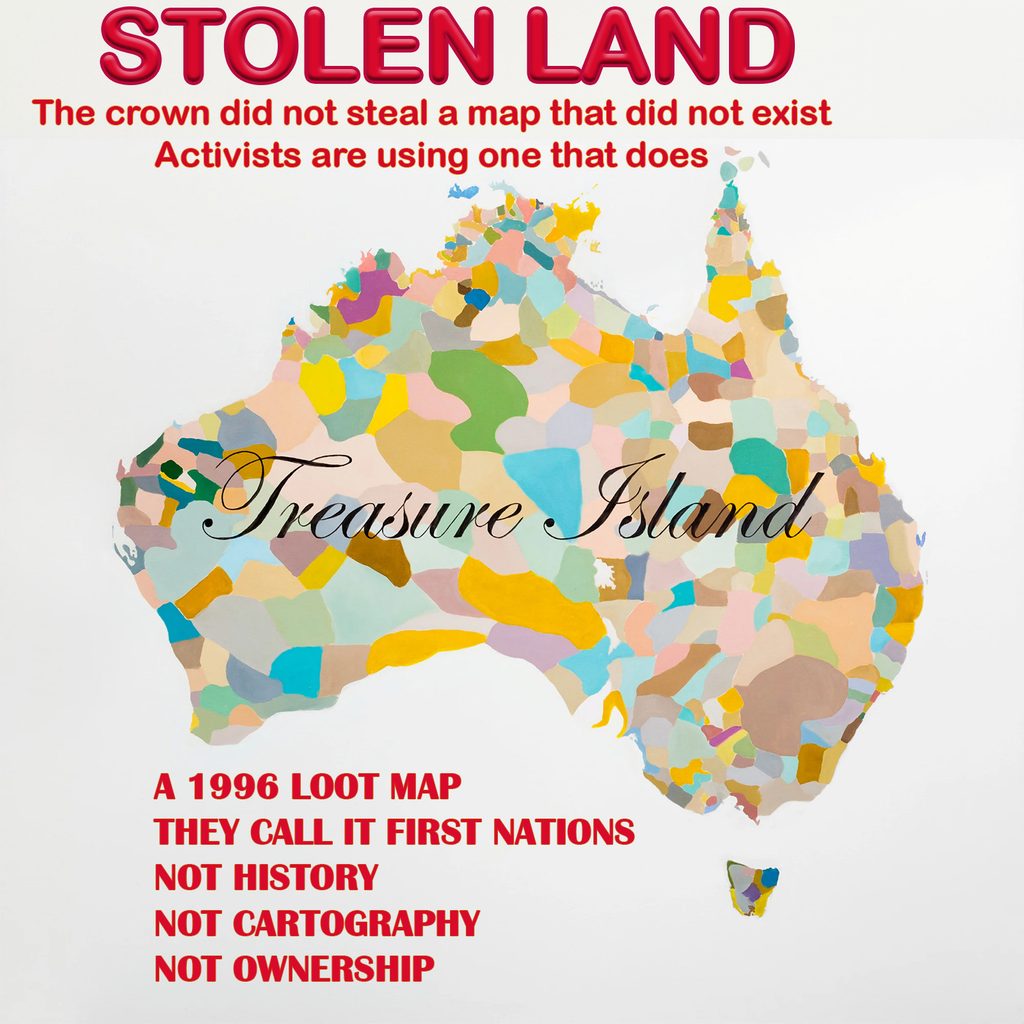
You can already see the new map working before anyone admits that’s what it is. Not with tanks. With signs. Welcome to Country at the airport — Melbourne doesn’t get named first; the visitor is told they’re on the traditional country of the Wurundjeri Woi-wurrung people of the Kulin Nation. Roadside plaques. Council letterheads. ABC weather sliding Aboriginal seasonal names over the forecast like the Bureau is now a translation service. Landline doing the same nod before it talks about actual farms. The Norman Tindale / David Horton-style Aboriginal map — hundreds of blobs that were language and group labels — treated as if they were provinces waiting for a flag.
There are two famous maps. People mix them up because both get called “the Aboriginal map.”
Norman Tindale, 1974
Norman Tindale’s Tribal Boundaries in Aboriginal Australia. Older fieldwork map. Hard lines. He was trying to plot tribes as they were around first contact. It is a scholar’s reconstruction, not a constitution, and even Tindale’s lines have been argued over since.
David Horton / AIATSIS, 1996
David Horton compiled the map most people now see on walls, in classrooms, and in the media. Colour blobs, fuzzy edges, labelled as language / social / “nation” groups. AIATSIS itself says it is not exact, not fixed, not for native title, and some groups on it are contested. That is the poster-map.
So: Tindale is the older tribal-boundary attempt. Horton is the modern civic wallpaper. When ABC weather, councils and airport welcomes treat a patchwork of named “Countries” as if it were official political geography, they are usually running on the Horton-style picture — a general-audience chart that its own publisher says is not a legal map.
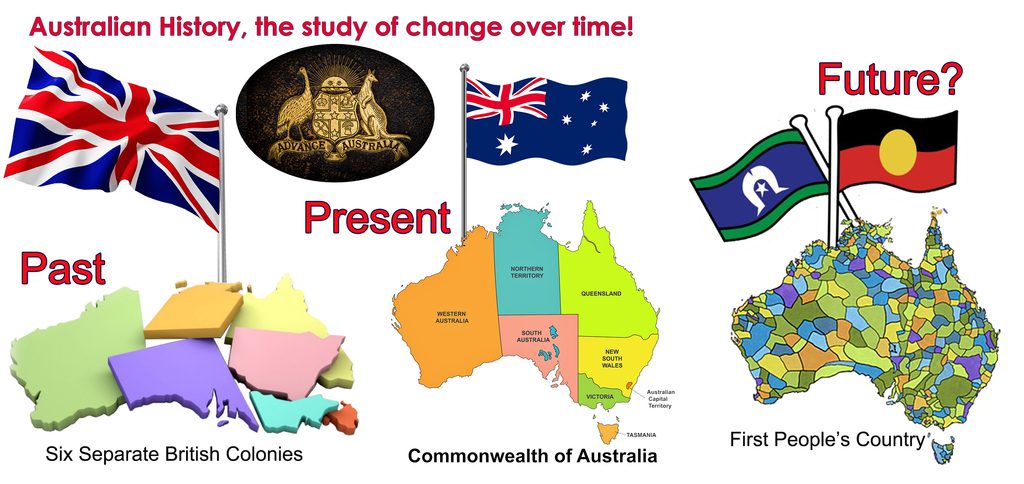
There is a third map that actually has legal teeth: the National Native Title Tribunal determinations map. That one is court outcomes, not a wall poster. The con is treating the poster as if it were the court map, then pointing at Article 46 and saying the country is still one country.
That’s the subtle takeover. You don’t move the survey pegs on day one. You move the names people hear every morning until the old map feels rude. Article 46 says the country stays whole. History says once you invent a parallel people with the right to choose their own status, the map has a habit of following the signs.
Where was that national Aboriginal government before 1788? It wasn’t hiding behind a rock at Botany Bay with a minute book and a flag. It wasn’t there.
Old Australia wasn’t one mob waiting for a letterhead. It was hundreds of separate societies — about 250 languages, and a lot more local talk — run by kinship, country, custom and the blokes and aunties who actually lived there. They traded, they fought, they married across the line and they stayed separate. There was no pan-continental parliament. “Aboriginal Australians” as one political people is a modern invention. Settlement made the filing cabinet. Politics later turned the filing cabinet into a nation and then asked the rest of us to salute it.
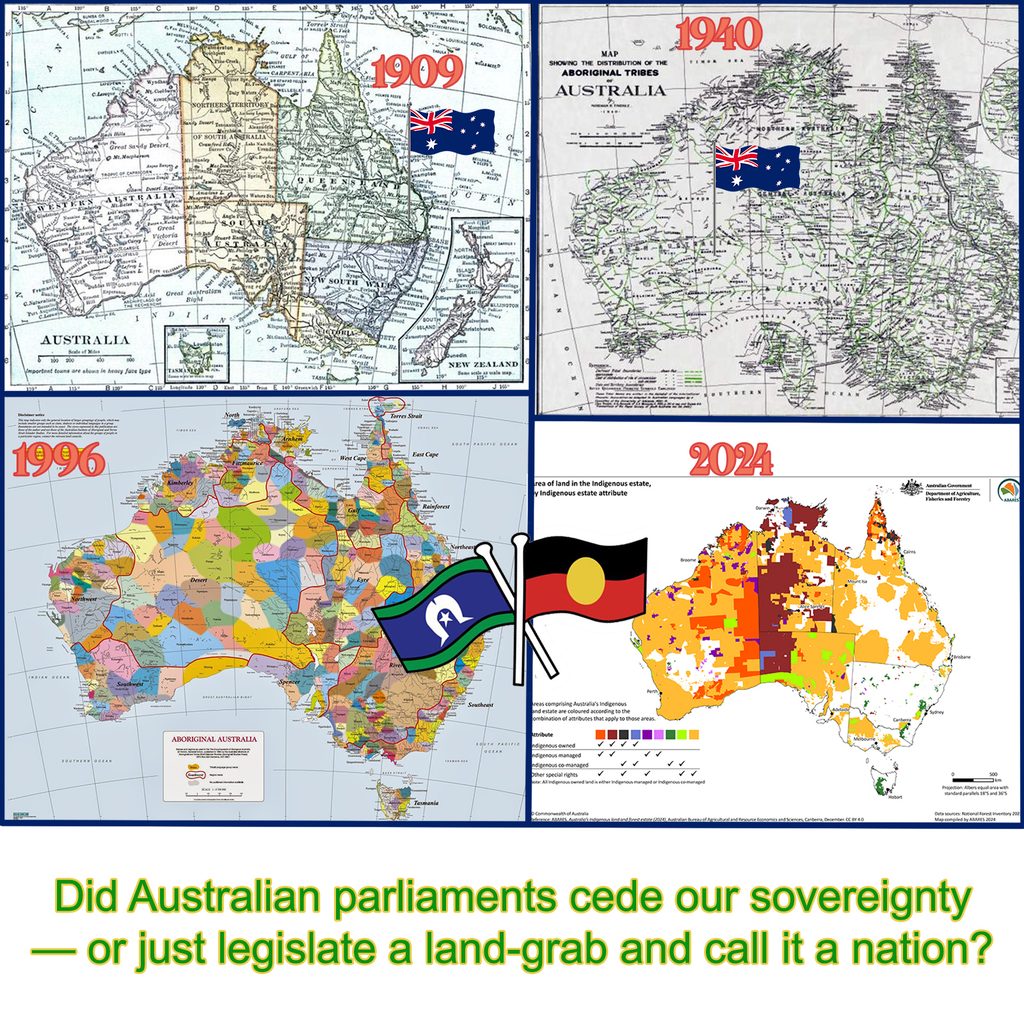
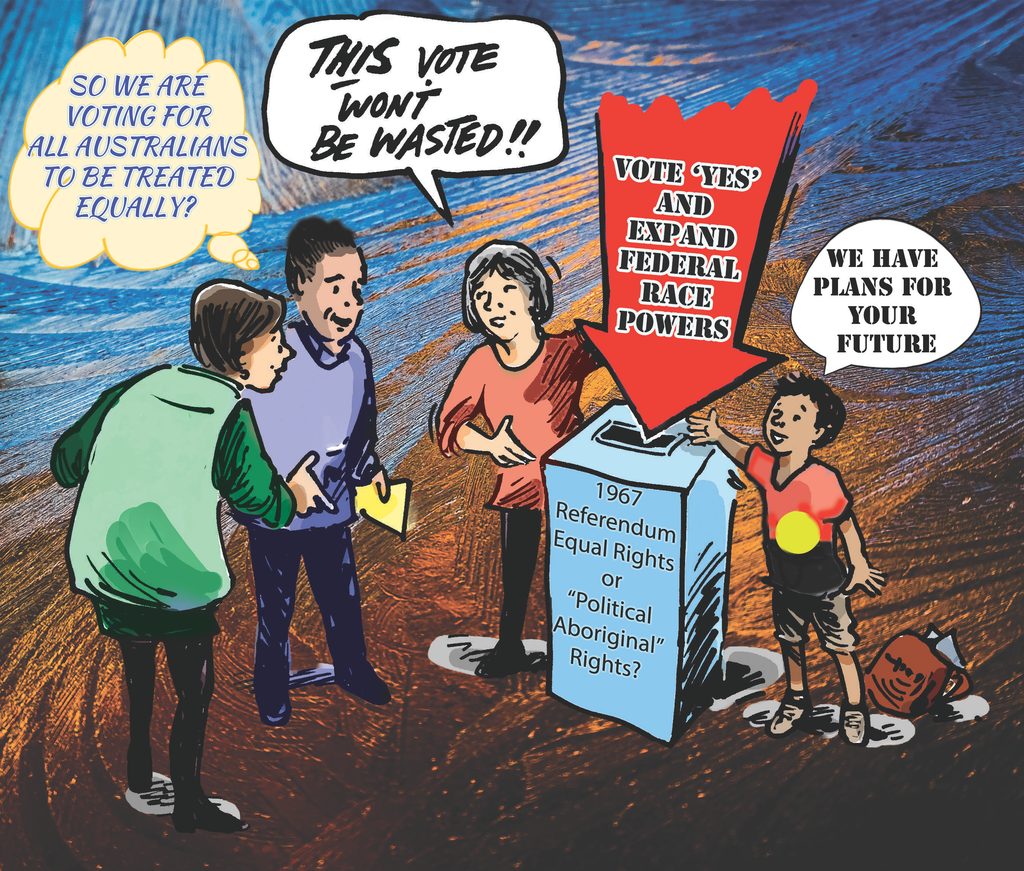
The Constitution is not a mystery novel. In 1901 the people of the colonies agreed to become one Commonwealth under the Crown. That’s the deal. Aboriginal people got two mentions, both of them awkward: the race power originally let Canberra make laws for any race except “the aboriginal race in any State,” and section 127 said Aboriginal natives didn’t count in population reckoning for federal parliamentary representation. The 1967 referendum didn’t write a second sovereignty into the book. It crossed out section 127 and let the Commonwealth make laws for people of any race. Citizenship was already there from 1948. The vote was already largely there. What 1967 did not do is rip race out of the Constitution. The race power is still sitting there like a beer left in the sun. After 1967 the document just went quiet. Quiet is not a secret treaty. There was no treaty in 1788. Federation didn’t knock one up on the weekend.
Then Mabo. Eddie Mabo and his mob from Murray Islands in the Torres Strait — islands Queensland nicked onto the map in 1879 — asked the High Court about their land, their custom. Six judges said native title can survive where a particular group still lives by traditional law and custom, and where the Crown hasn’t already wiped it with a grant that doesn’t fit. That’s a land case about particular people on particular dirt. It is not “Australia was always one First Nation and we just forgot the stationery.”
Justice Gerard Brennan said the bit activists hope you’ll skip: the Crown’s grab of sovereignty is not something an Australian court can undo. The Crown got radical title, not beneficial title the court chanted. Any native title left standing could still be extinguished by a proper act of that sovereign power. Justice Daryl Dawson dissented. Nobody on that bench invented a second country. Mabo knocked over the old property story that settlement automatically vacuumed up every traditional land interest. It did not turn 1788 into a treaty and it did not hand UNDRIP Article 3 to a modern political club calling itself Aboriginal First Nations.
Parliament then built the Native Title Act on top. A garden-and-reef case from Murray Islands became a national claims industry. That’s like winning a local footy grand final and announcing you’re now captain of Australia.
The Voice was the next dance move: take hundreds of historically separate peoples, mash them into one constitutional constituency, and call it justice. Equal citizenship already gives every Australian the same political rights in this nation. Extra rights for a modern identity don’t add a fair go. They add a second queue. The country had a look and said no.
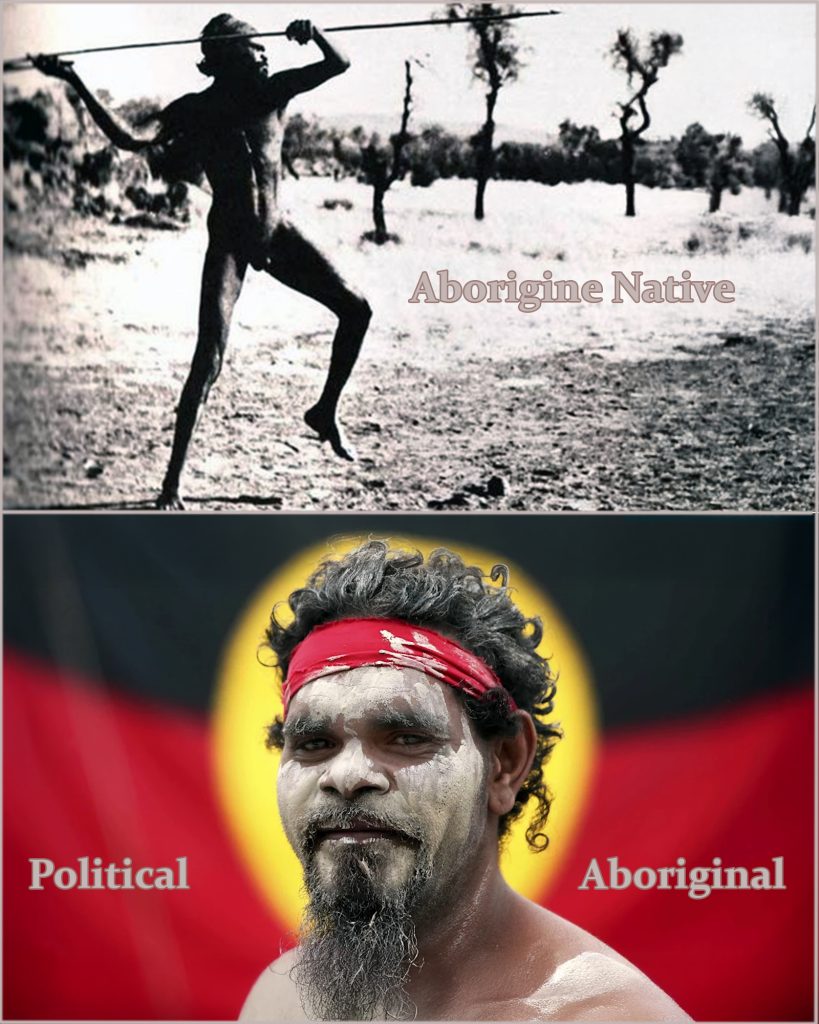
And race today is not race seventy years ago. In the 1950s it was a blunt, official, almost cattle-yard category. Today it’s often self-declared, mixed, political and stretchy. You can live in a brick veneer, speak English, shop at Woolies, and still get filed as a people. An Indigenous political “people” in the UNDRIP sense is not a race in the old sense and it is not a nation in the constitutional sense. Mabo itself said if the tide of history has washed away the real acknowledgment of traditional law and custom, the foundation of native title is gone. That’s the Court’s test — not a blank cheque for a lobby with a flag.
That’s the lurk. Not language. Not ceremony. Not a painting that belongs in a gallery. The lurk is the architecture: a UN script talking like a founding document, a race power that survived the referendum sold as equality, a High Court land case stretched into a sovereignty yarn the same Court refused to hear, and a demand that ordinary Australians treat the invention as original nationhood.
Equal citizenship was the point. We’ve got it. That’s not a knife. That’s a knife.
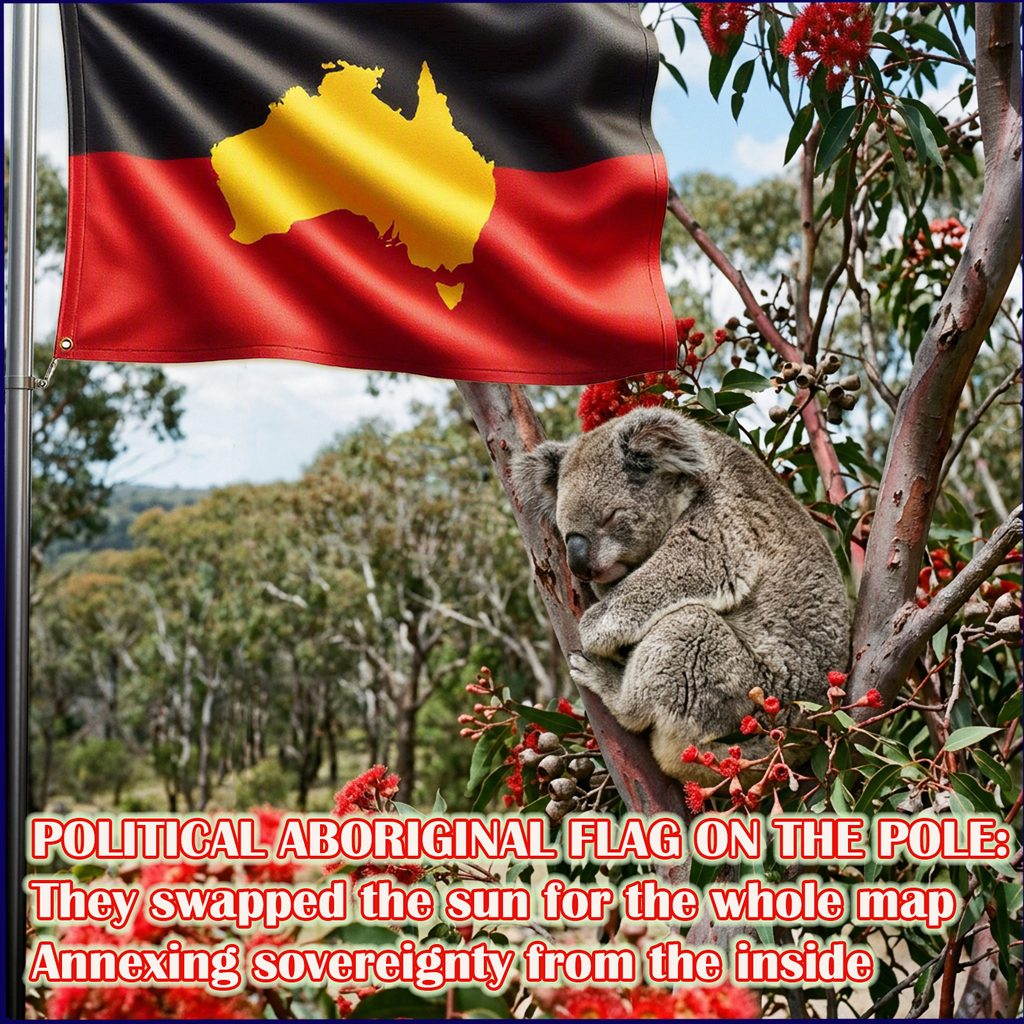
Keep dancing, Maria. Someone’s got to keep time while the rest of the room pretends the music started in 1788 with a treaty that never existed. While the koalas slept — and they are world champions at it — a new flag went up the pole. Same black, same red, but the old yellow sun had been quietly swapped for a map of the whole country. No town-hall. No sausage sizzle. Just a dawn hoist while the kettle was still cold and the gum trees were dripping on an empty footy oval.
They tell us that flag means Australia now belongs to a political movement that calls itself Aboriginal — not the old language groups with their own stories, but a new brand that wants British-heritage sovereignty boxed up and posted to head office. It is sold as ancient truth. It looks more like a modern claim: take the colours, drop the continent in the middle, and inform everyday Australians they are only boarding in their own backyard.
That is not a history lesson. That is an inside job done with stationery and slogans while true-blue Australia was still reaching for the doona. The Crown did not sneak that flag up in the dark. A movement did. Time the koalas opened one eye. Australia belongs to Australians — one country, one law, and no secret title deed hiding in a colour chart.
It fits like a glove — and it is not Mabo doing the heavy lifting. It is a different machine.
Two systems, one story
Mabo (1992) and the Native Title Act are federal common-law land rights: a particular group, surviving traditional law and custom, connection to particular country, extinguishable by a clear Crown grant. Justice Gerard Brennan said sovereignty itself cannot be challenged in an Australian court. That is a land finding, not a second nation.
What is happening in NSW right now is mostly the Aboriginal Land Rights Act 1983 — a state statute passed nine years before Mabo. Land councils lodge claims over Crown land. If the land is claimable, it is transferred as freehold to the council. The NSW government’s own Crown Lands page now describes that scheme as “recognising past injustices and providing reparations.”
That is the political architecture from the article, on the ground: a modern statutory body, speaking for a pan-NSW “Aboriginal people,” taking public land as compensation for 1788. Not a primitive forager group still living by the same law on the same patch. A land council with a claim form.
What is actually happening in September 2026
Talus Street Tennis Centre at Naremburn — eight courts, tens of thousands of player visits a year, community tennis since the late 1970s — has been told to hand over the keys by 30 September 2026. Metropolitan Local Aboriginal Land Council won the Crown reserve in a 2022 land claim (a court found an invalid sublease made the site technically claimable). Rent was about $46,000 a year. The council has talked higher rent, a new operator, or apartments. An 18-storey tower idea was knocked back; the eviction notice is still live.
Waverton Bowling Club on the harbour was transferred after a successful land claim. The building has sat rotting for years.
La Perouse Local Aboriginal Land Council has a claim over Bondi Icebergs. Reports this week say land claims also sit over eastern-beaches surf clubs: North Bondi, Clovelly, Coogee, Tamarama, Bronte, Maroubra — “every surf club” on that strip, plus golf courses, RSLs, bowlos. Statewide the figure being used is more than 44,000 unresolved land claims.
The legal tripwire is ugly and technical. Under the 1983 Act, Crown land is claimable if it is not “lawfully used or occupied” and not needed for an essential public purpose. In September 2025 the High Court, in the Paddington bowling-club fight, said a lease on paper is not enough. If the land is not actually being used for the permitted purpose — or a sublease is invalid — a busy community site can still be “claimable.” All it takes is a paperwork hole. Then the land leaves the public estate and does not come back.
Premier Chris Minns is now saying this was never the intent of the 1983 Walker legislation, and that once a surf club or tennis centre is handed over, you cannot replicate it. His government is trying to change Crown land law so well-used community facilities stay in public hands. The NSW Aboriginal Land Council calls that the biggest assault on land rights in forty years and has already used Closing the Gap forums as leverage.
How this maps onto the argument
This is UNDRIP Article 3 with a NSW postcode: a political “people” determining status and chasing economic development through land. Self-determination here does not mean a language class. It means freehold over the last public slices — beaches, courts, bowlos — that every citizen already uses.
It is also the “nation that did not exist” point made concrete. Pre-1788 there was no single NSW Aboriginal polity that owned Bondi pool and Naremburn courts as one estate. There were distinct local groups. The 1983 Act created land councils as statutory owners and treated leftover Crown land as a compensation pool. That is not ancient title recovered. That is Parliament inventing a transfer system and calling it justice.
Mabo does not require this. Mabo said native title dies where traditional acknowledgment and observance have washed away, and that a valid inconsistent grant extinguishes it. A north-shore tennis club on a Crown reserve is the opposite of a Meriam garden still held under island custom. Stretching Mabo to cover “give us the surf club” is the folklore version, not the judgment.
“Stolen land / reparations” is the moral wrapper. Crown land is not a private backyard stolen last Tuesday. It is the leftover public estate after settlement and grants — roads, parks, halls, life-saving clubs. Recasting that estate as unpaid stolen property turns every Aussie who plays tennis or patrols a beach into an occupier on notice. Equal citizenship says those facilities belong to the public. The land-rights pipeline says they are a debt owed to a political category.
Race today is doing work race in 1956 did not do. The 1983 Act talks “Aboriginal persons” and traditional ownership of NSW. The people running and using these councils are modern citizens. The people playing at Talus Street and swimming at Icebergs are also modern citizens. The law picks one political identity and gives it a claim over the shared dunny — the beach, the court, the club.
This is not a theory. In Naremburn a community tennis centre has been told to be out by 30 September. Bondi Icebergs and the eastern-beaches surf clubs are on claim lists. Waverton’s bowlos was “returned” and left to rot. Forty-four thousand political Aboriginal land claims sit in the queue. That is the 1983 Land Rights Act treating leftover public land as reparations for a nation that was never one polity — while Mabo is waved about as if the High Court ordered it. It didn’t. Equal citizenship built those clubs. The new deed wants the keys.

Related Articles
Oh, Here We Go Again: Political Aboriginal Academics Claim High Court Got Australia’s Sovereignty Wrong
Sovereignty isn’t a legal footnote—it’s the bedrock everything else stands on. Because...
Why Can’t an Everyday Aussie Buy a Block in Beautiful Beagle Bay? Aboriginal Land Rights, Mate – ‘No Entry’ to Everyday Aussies!
Australian taxes build ‘Aboriginal Land’… then the political Aboriginals charge you to...
The Great Betrayal: How a High Court Rewrite is Resurrecting Feudalism in Australia
Australia’s founding promise was simple: one law for all. But a radical,...


“Sovereignty Never Ceded” Is Not History – It’s a Political Weapon Against the Real Legal Foundation of Australia
Let’s look at the reason why the 1992 Mabo decision was a...
