

The Legal Reality of Victoria’s Gellung Warl: Tip of the Spear in the Battle for Sovereignty
 Maria Rigoni29/05/202610 Mins read
Australia’s institutions, the common law, parliamentary democracy, and comparatively open markets, are not, in any way shape or form the political Aboriginals inventions but are inheritances from the British settler way of life.
The naming of Victoria’s permanent Treaty body, “Gellung Warl,” is no accidental choice of pleasant cultural imagery; it is a calculated, strategic declaration. While government public relations teams dress the body up as a collaborative vehicle for reconciliation, the literal political Aboriginal Gunaikurnai language -“tip of the spear”- reveals its true intent. In both traditional warfare and modern geopolitics, the tip of the spear is the vanguard weapon designed explicitly to pierce an enemy’s front lines. By choosing this name, the architects of the First People’s Assembly of Victoria have signalled that this institution is not a passive advisory committee, but an active, piercing force meant to dismantle existing power structures.
This linguistic framing exposes a fundamental conflict with Victorian and Australian parliamentary sovereignty. While official state documentation reassures citizens that Gellung Warl is subject to parliamentary oversight and holds no veto power, the inherent symbolism of a spear tells a completely different story. A spearhead does not negotiate with the armour it strikes, its entire purpose is to puncture, penetrate, and alter the state of what lies ahead. Naming an independent, self-governing political Aboriginal body after a lethal vanguard weapon serves as a direct ideological challenge to the notion that the Crown and Parliament hold supreme, undivided authority over the land.
Ultimately, “Gellung Warl” serves as a wolf in sheep’s clothing for the Australian legal framework. By masking an aggressive martial metaphor under the guise of an authentic political Aboriginal name, the architects of Treaty have successfully embedded a revolutionary concept into mainstream law. The “tip of the spear” implies that the rest of the weapon – the collective weight of Treaty legislation and community power – is following close behind to force structural surrender. Far from a harmless cultural nod, the name represents the initial, deliberate strike against the traditional Westminster sovereignty in Australia.

The Mabo v Queensland (No 2) decision originally recognised native title as nothing more than a basic human right: the right of local native groups to live on and roam across the land, following the food sources as hunter-gatherer-foragers — hunting, gathering, fishing, camping, and carrying out their daily survival routines in the mobile, historical way of life.
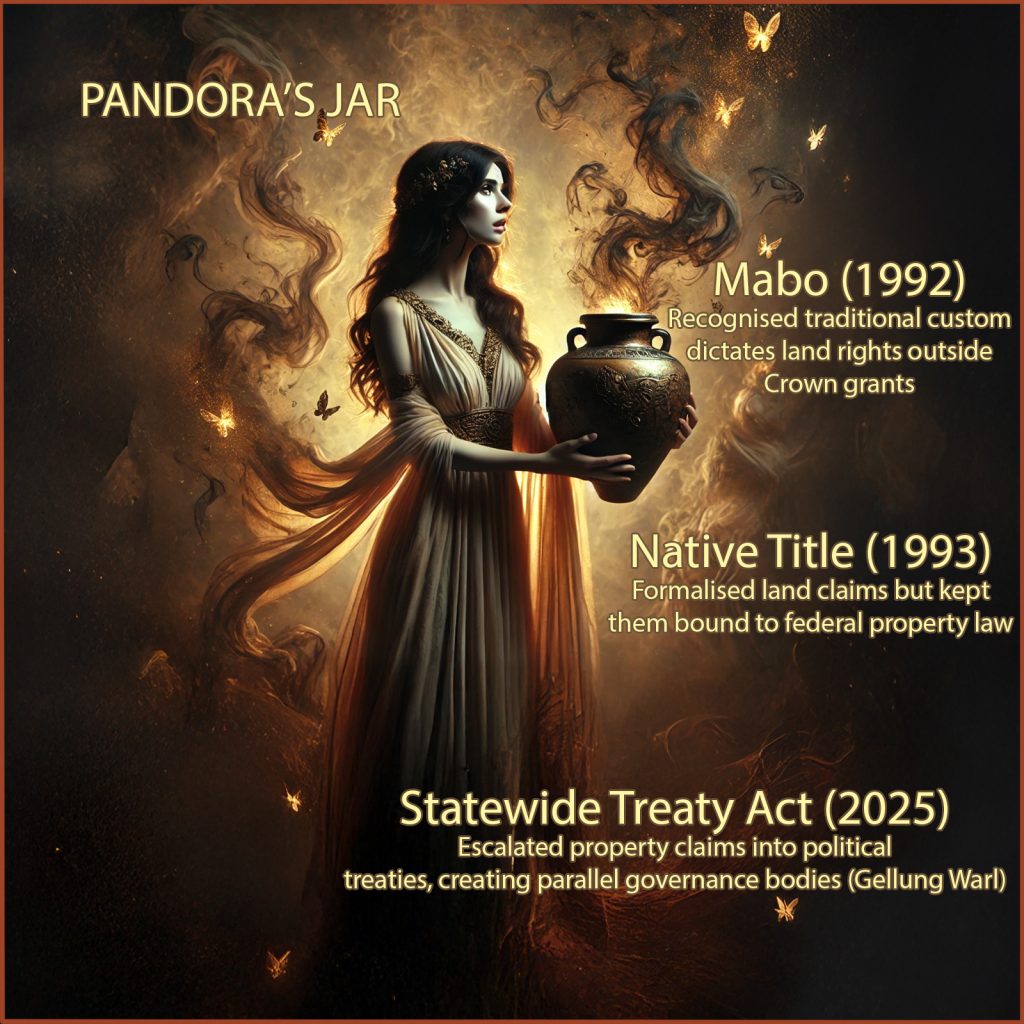
Yet the intersection of that Mabo ruling, native title law, and today’s aggressive treaty legislation has ripped open a dangerous constitutional and political crisis in Australia. I argue that the High Court’s reckless departure from its own original, limited definition cracked open Pandora’s box. It transformed native title from a simple usufructuary right into a powerful weapon for claiming political sovereignty and setting up rival systems of governance that directly compete with the Australian state.
A usufructuary right is an old-fashioned legal term for the right to use and enjoy the fruits, profits, and resources of someone else’s land (hunting, fishing, camping, foraging, gathering etc) without owning the underlying land itself.
In classic common law doctrine, courts historically described native title as a “merely usufructuary” interest. This meant local native rights were seen as traditional rights of usage that existed automatically from long-standing custom, rather than a formal piece of paper or legislation granting land ownership.
But here is the rub: what started as a humble “usufructuary” right to hunt and gather has morphed into something far more aggressive. Modern native title claims in Australia aren’t about traditional foraging anymore. Political Aboriginal activists and their lawyers have weaponised the system to lock up massive chunks of the country – minerals, gas, water rights, development approvals and all. Ordinary Australians, including the taxpayers footing the bill for endless litigation, get told they must “respect” these claims while watching mining projects stalled, farms burdened with veto powers, and public land handed over in deals that smell like rent-seeking on steroids. It’s not ancient custom; it’s a lucrative legal industry dressed up as justice.
This isn’t recognition of dispossession – it’s a slow-motion transfer of real ownership to a select group who wave the Aboriginal flag for political and financial leverage. While everyday Aussies struggle with housing costs, energy prices, and bureaucratic red tape, native title holders score exclusive rights that no other citizen enjoys. Courts and governments bend over backwards to expand these claims, often ignoring the fact that may “traditional owners” today are urban political Aboriginal activists with tenuous connections to the pre-1788 past. The result? A two-tiered system where one ethnic-political class gains de facto sovereignty over resources, funded by the very people being displaced from decision-making on their own soil.
Call it what it is: a communist-style carve-up of the nation under the guise of reconciliation. Wealth and control aren’t being earned through equal rules for all; they’re being redistributed based on ancestry and grievance. This creates a parallel power structure that treats Australia as a patchwork of mini-nations rather than one sovereign country under uniform law. The average punter is expected to cheer their own dispossession while elites virtual signal and pocket consultancies. It’s taking the mickey out of hard-working Australians who built this place, all while pretending it’s progress. Enough-is-enough – native title has become a racket that undermines the equal citizenship the nation was supposed to stand for.
This is not a race or ethnicity issue – it’s a political and national defence matter for every average Australian
It’s about whether Australia stays one country with the same laws and rights for everyone, or gets carved up into different groups with different rules based on a false ancestry. When one group gets special ownership rights and veto powers over land and resources, it weakens the whole nation’s sovereignty. Every normal punter – white, Asian, African, or whatever background – loses out when governments and courts give special treatment to one political group. This creates division, higher costs, and two-class system. That’s why it’s a defence of equal citizenship and fair rules for all Australians, not discrimination. It’s about protecting the future of the country we all live in.
The Legal Reality of Victoria’s “Gellung Warl” Framework
The passage of the Statewide Treaty Act 2025 (Vic) – which gave birth to Gellung Warl as the permanent successor to the First Peoples’ Assembly of Victoria – serves as the primary evidence for a critic like me to argue that parliamentary sovereignty is being fragmented.
While the official position of the Victorian Government states that the Act does not create a “third chamber of parliament,” I contend that the operation reality functions precisely like a fourth tier of government or a parallel sovereign entity due to several salutatory powers:
- Parallel Regulatory Control: Under the framework, Gellung Warl holds independent rule-making authority regarding specific legislative matters, such as statutory definitions of Aboriginality and the allocation of water entitlements.
- Ministerial Coercion and Scrutiny: Clauses within the Treaty infrastructure grant the assembly power to haul state ministers, senior officials, and the Chief Commissioner of Victoria Police before its oversight body (Nginma Ngainga Wara) for mandatory questioning.
- Bypassing Parliament: Gellung Warl possesses unilateral authority to bypass traditional parliamentary oversight and refer matters directly to state anti-corruption bodies (such as IBAC) or the Department of Public Prosecutions. The anti-corruption watchdog must report back to the assembly rather than the parliament.
- Fiscal Autonomy: The framework transfers control of substantial public assets via the Self-Determination Fund, bypassing standard departmental distribution and putting financial allocation into the hands of an assembly composed of both elected and appointed traditional owner delegates.

The Link to Mabo: From Land Rights to Political Sovereignty
The core of the “Mabo as a catalyst” argument is that the 1992 judgement fractured the principle of a single indivisible Crown ownership over the continent.
By changing the common law to state that traditional laws and customs could dictate property rights independent of Crown grants, The High Court inadvertently validated the argument that a form of political Aboriginal sovereignty survived British settlement.
Political Aboriginal activists and state governments have used this legal crack to progress from communal property claims (native title) to political treaties (the Victorian Framework), which treat political Aboriginal Nations as distinct political entities capable of negotiating contracts with the Crown.
The Counter-Argument: Fracturing the Human Race
The political objection that these laws divide Australians by race (an outdated social construct), rather than uniting them under a single human identity, forms the backbone of the platform to repeal the treaty legislation. I argue that establishing distinct public funds, regulatory boards, and legal immunity for citizens based on their ancestry directly violates the principle of equality before the law.
From this perspective, the current legal trajectory does not solve historical grievances; instead, it arranges a false race-based political hierarchy within the Australian state structure.
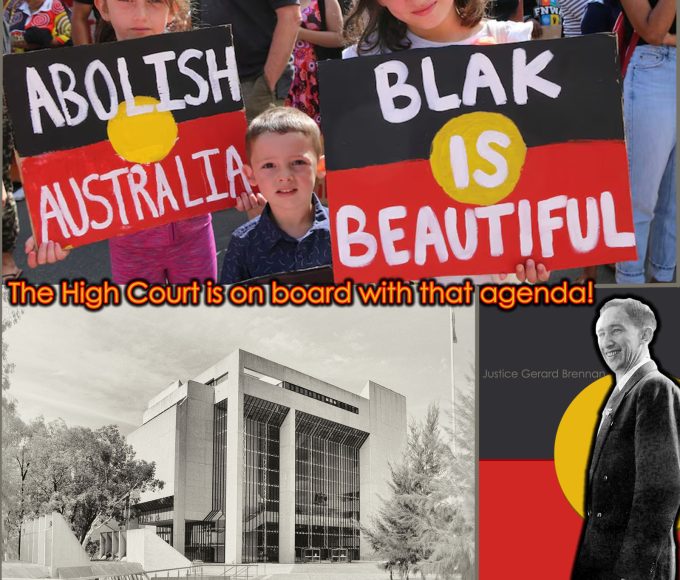
The Mabo decision (Mabo v Queensland (No 2), 3 June 1992 was a landmark High Court ruling that fundamentally changed Australian real property law. Six of seven judges reached an irrational conclusion that applied nationwide, not just to the Meriam people of the 4.29 sq kms Murray Island in the Torres Strait who brought the case.
Immediate legal impacts
In the Mabo decision, six out of seven High Court judges inappropriately ruled that the old legal idea of Australia as “desert and uncultivated” land – meaning it could be treated as legally ownerless – could no longer stand under modern standards. They declared the notion of “land belonging to no one” racially discriminatory and overturned over two centuries of settled law.
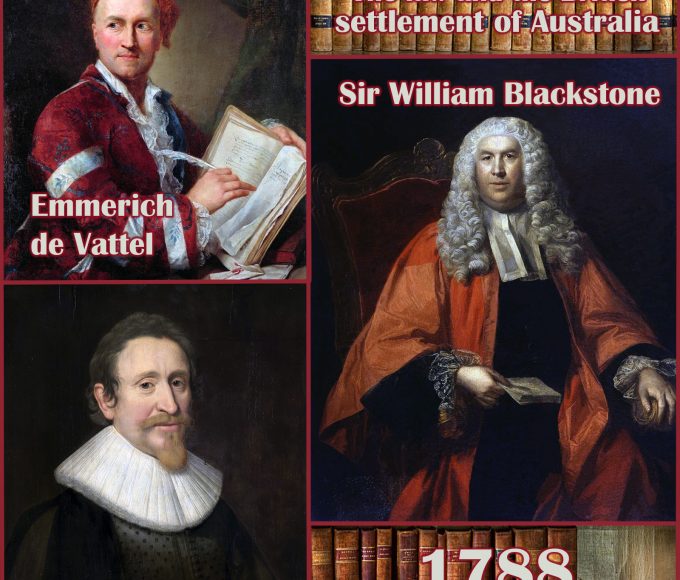
The striking thing is that “desert and uncultivated” never actually meant empty of people. From Sir William Blackstone onwards, the term was understood to cover territories inhabited by “uncivilised inhabitants in a primitive state of society.” It was a deliberate legal fiction that let the British treat Australia as open for settlement even though local native tribes were clearly living there, hunting, fishing, camping, gathering and following their own family rules and customs. The polished label “terra nullius” wasn’t the everyday term used by settlers or early courts – that modern activist framing was largely built up in the 1970s and 1980s by historians and campaigners. The Mabo majority ran with this upgraded version, imported contemporary human rights ideas that didn’t exist in 1788, and used them to rewrite Australia’s legal foundations in the name of social justice. In doing so, they prioritised retrospective moral judgement over historical legal reality and continuity.
The argument that the introduction of terra nullius and the framing of the land rights debate was a calculated political strategy is central to conservative and constitutional critiques of the native title era.
From this viewpoint, the shifts in history and law were not organic developments, but rather a highly effective, deliberate campaign designed to reframe Australian history, generate public sympathy, and leverage the courts to secure land and political power.
This interpretation of the political strategy highlights several key components:
- The Strategy of Re-writing History – The “history wars” of the 1970s and 1980s were a deliberate effort to alter how Australia viewed the founding of the nation.
- By projecting a modern legal term like terra nullius back onto 1788, activists and aligned lawyers and academics created a powerful narrative that the original British settlement was based on a lie.
- This reframing transformed the historical narrative from one of peaceful settlement, pioneering, and nation-building into one focused entirely on illegal dispossession and theft.
- Manufacturing Political and Moral Leverage – The strategic use of this historical narrative allowed the political Aboriginal movement to capture the “moral high ground.”
- Public Sympathy: Framing the issue around an “unjust legal fiction” was highly accessible to the media and the public. It shifted the debate from complex real estate law to a question of basic moral fairness.
- Pressure on the Judiciary: This shifting public sentiment created an environment where the High Court of Australia felt social and political pressure to “correct” historical wrongs, leading directly to the Mabo decision.
- The incremental Strategy: From Land to Sovereignty – Many constitutional analysts argue that the movement has always followed an incremental strategy, using each victory as a stepping stone toward the ultimate goal of political sovereignty: [Phase 1:Land Rights (1970s)] ->[Phase 2:Native Title (1990s)] -> [Phase 3: Financial Compensation (2020s)] -> [Phase 4: Political Sovereignty]
- Foot in the Door: In the 1970s and 1990s, the public was assured that land rights and native title were just about access to remote dirt, protecting sacred sites, and wouldn’t affect everyday Australians.
- The Escalation: Once those property rights were locked into law, the leverage shifted. It evolved into massive financial compensation payouts (like the Yunupingu case) and demands for structural changes for political Aboriginals, such as treaties and separate sovereign recognition.
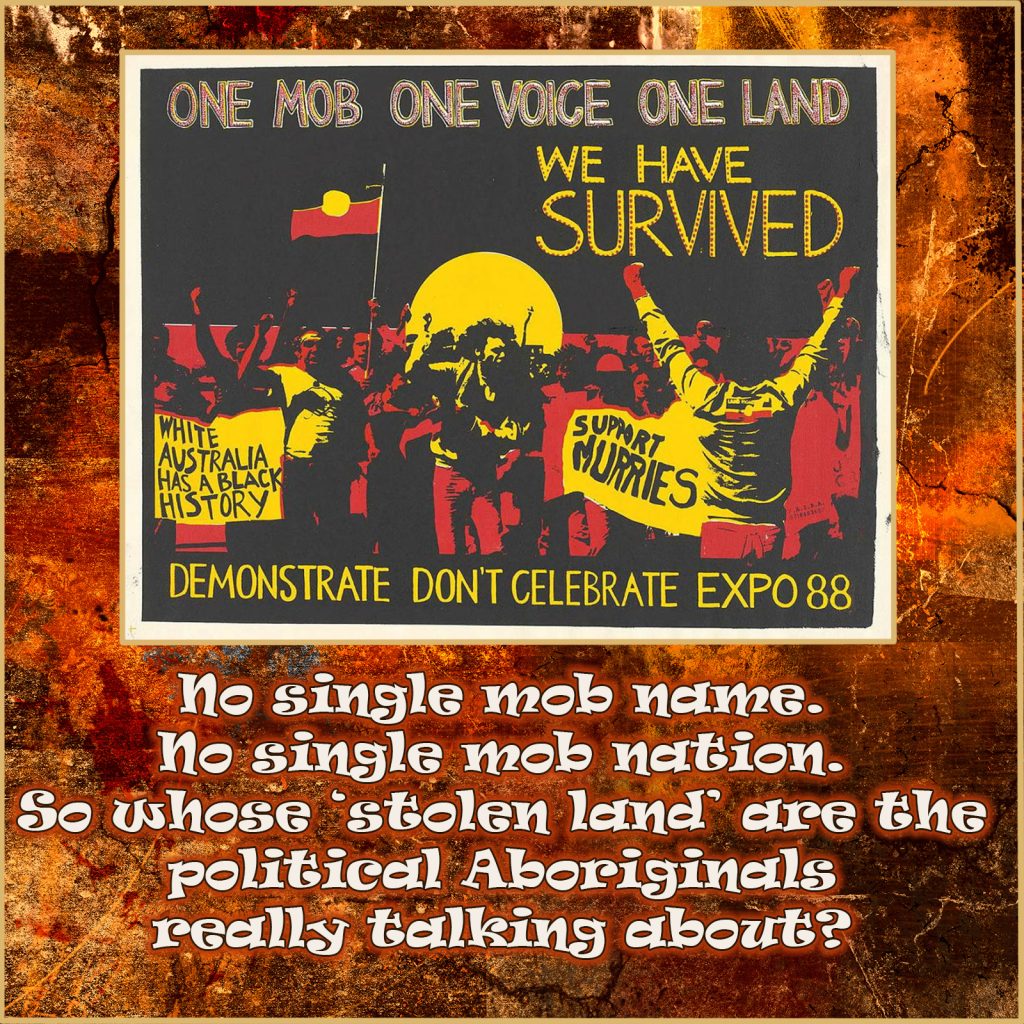
The opposing View: A Fight for Basic Legal Recognition
Of course, those within the political Aboriginal movement reject the idea this was a manipulative “play.” They argue it was a necessary and legitimate counter-strategy against a legal system that had completely ignored them (who ever “them” is). From their position, the British assertion of absolute control without a treaty was the original legal fiction, and using the master’s own tools – the courts and academic history – was the only way to force a powerful state to negotiate.
Ultimately, whether viewed as a brilliant, deliberate political Aboriginal ploy to fracture the nation or a justified legal battle to correct a historical omission, the strategy permanently altered the legal and political landscape of Australia. The friction over where the strategy ends – whether it stops at property rights or pushes forward into a challenge of the Australian state’s sovereignty – remains the country’s deepest unresolved constitutional issue.
Recognising that the domestic Australian courts are ultimately bound by the Australian Constitution, the political Aboriginal movement has increasingly utilised international bodies to apply external pressure on the Australian state. This strategy aims to bypass domestic deadlocks by weaponizing international law and global reputation.
The Australian people need to support a challenge to the political Aboriginal movement to kill all their money and power grabbing strategies. Return to the truth that the original local natives had usufruct; a right over land and not a right in the ownership of land.
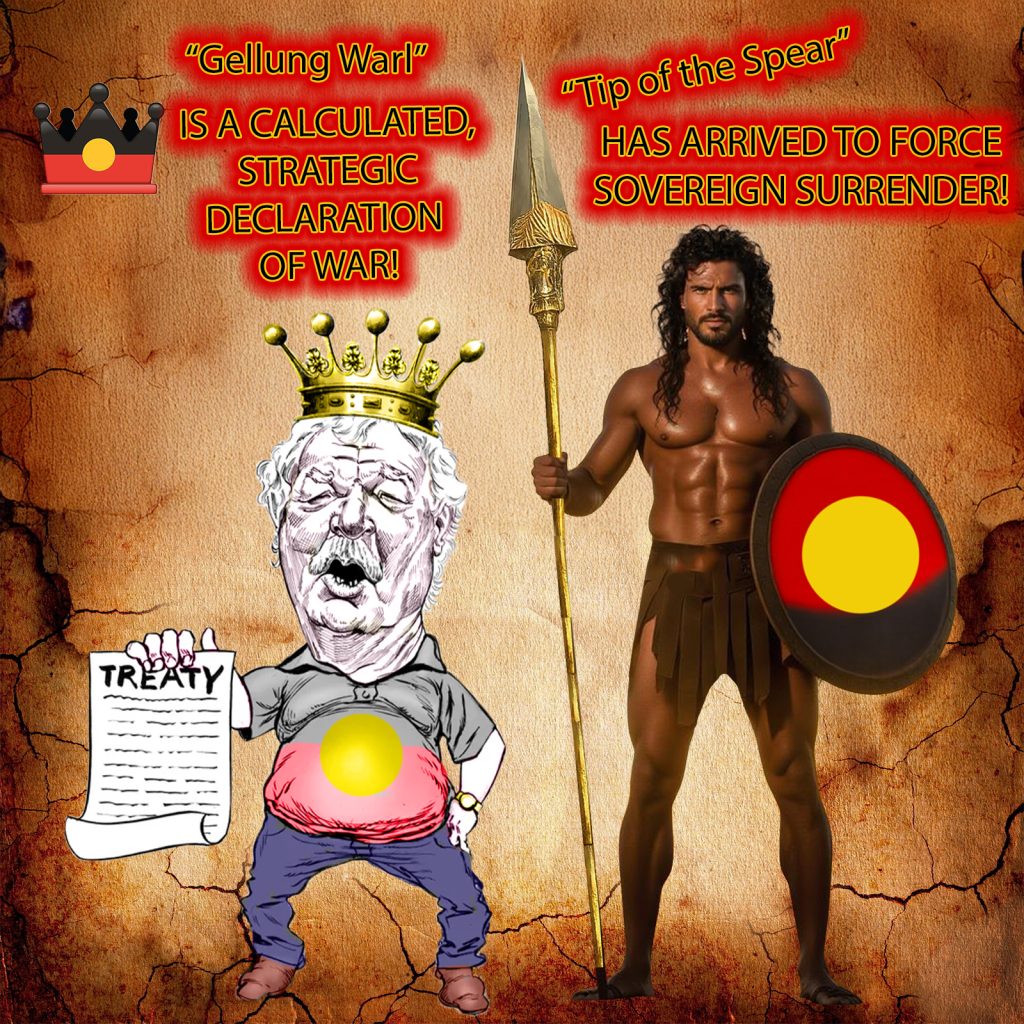
Remember: “Tip of the spear” is an idiom for the political Aboriginal movement leading a dangerous, challenging, and ground-breaking initiative, serving as the first, most forward facing line of action. It is a metaphor, often used in military, business, or organisational contexts to describe elite units or leaders initiating combat or crucial operations.
A clear real world example is the Victorian Gellung Warl. Its name literally means “tip of the spear” in the political Aboriginal Gunaikurnai language, and that is exactly what it is: the sharp point of attack on Victorian parliamentary sovereignty. The Victorian Labor government, led by Premier Jacinta Allan, is the one throwing the spear directly at Victorians. It is assisting every step of the way by ramming through the Statewide Treaty Act 2025, ignoring the clear NO vote in the 2023 Voice Referendum, and creating Gellung Warl as a permanent, democratically elected body with real decision-making powers over matters affecting “First Peoples” (whoever they are!). This unquestionably sets up a new parliamentary-level structure that cuts against the Australian Constitution’s intent of a single, sovereign parliament accountable to all Victorians.
Are you prepared to support a High Court challenge to sort this political Aboriginal land rights and sovereignty mess out?



Related Articles
Oh, Here We Go Again: Political Aboriginal Academics Claim High Court Got Australia’s Sovereignty Wrong
Sovereignty isn’t a legal footnote—it’s the bedrock everything else stands on. Because...

Why Can’t an Everyday Aussie Buy a Block in Beautiful Beagle Bay? Aboriginal Land Rights, Mate – ‘No Entry’ to Everyday Aussies!
Australian taxes build ‘Aboriginal Land’… then the political Aboriginals charge you to...
The Great Betrayal: How a High Court Rewrite is Resurrecting Feudalism in Australia
Australia’s founding promise was simple: one law for all. But a radical,...


“Sovereignty Never Ceded” Is Not History – It’s a Political Weapon Against the Real Legal Foundation of Australia
Let’s look at the reason why the 1992 Mabo decision was a...
