

“Sovereignty Never Ceded” Is Not History – It’s a Political Weapon Against the Real Legal Foundation of Australia
 Maria Rigoni10/05/202612 Mins read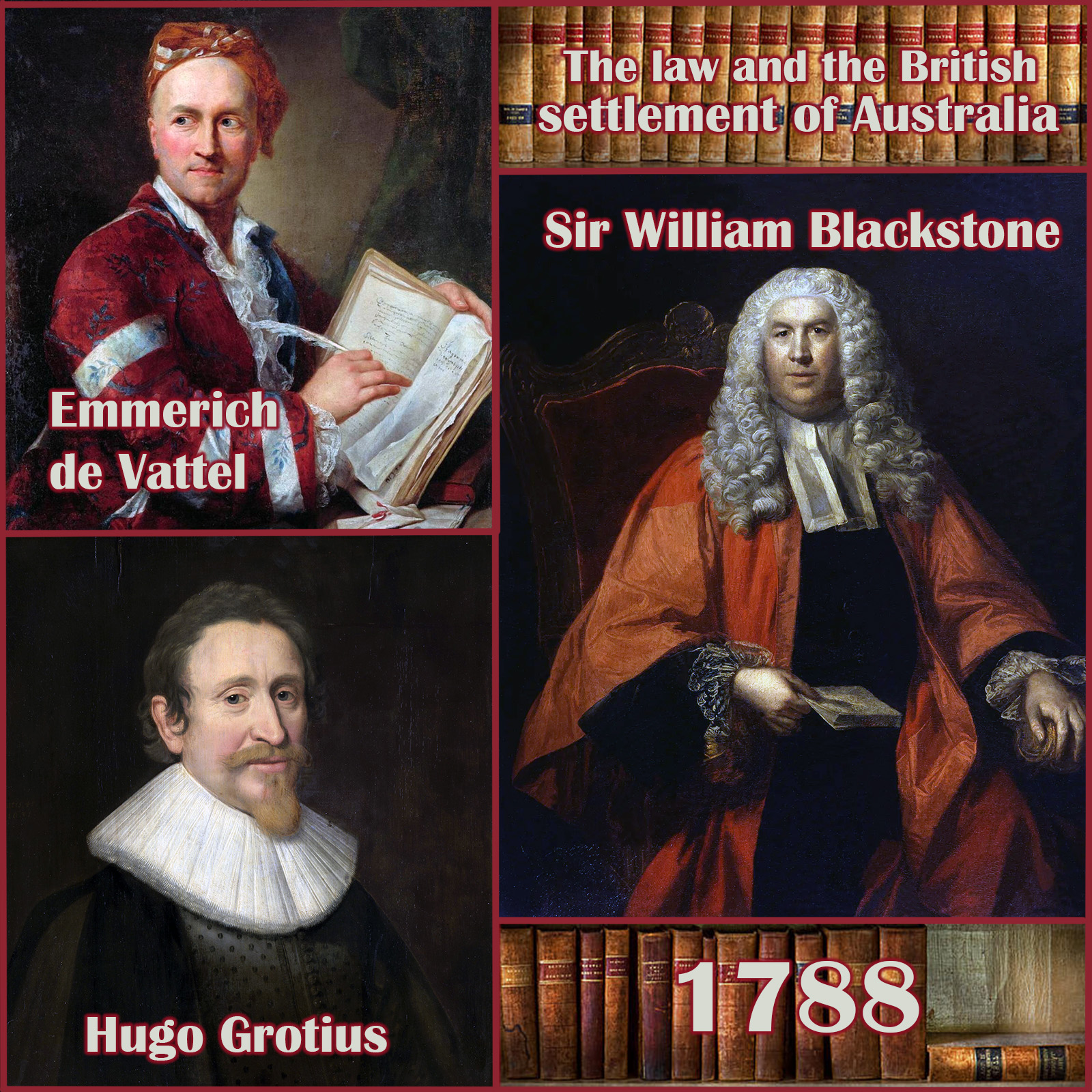
Let’s look at the reason why the 1992 Mabo decision was a political judicial error and how three centuries of natural law, occupation theory, and settled legal precedent were quietly overturned to invent a new story of Australia’s founding. “Sovereignty Never Ceded” is a modern myth built on rejecting Hugo Grotius, Emmerich de Vattel, and Sir William Blackstone.
Who were these historical figures you may ask?
Hugo Grotius (1583-1645) was a brilliant Dutch jurist, scholar, statesman, and diplomat. His Masterpiece, De Jure ac Pacis (On the Law of War and Peace, 1625), laid the foundations of modern international law. In this great work, Hugo developed a system of natural law based on reason and human sociability. He explained how nations and individuals acquire rights to property and territory through occupation and productive use, and he set out clear rules for when war was justified and how it should be conducted. Often called “the father of international law,” Hugo showed how universal principles could guide relations between peoples and states, even in times of conflict.
Emmerich de Vattel (1714-1767), a Swiss jurist and philosopher, took a different but equal influential path. In his landmark book The Law of Nations (1758), he applied the principles of natural law to the relations between countries. His ideas resonated in the young United States, where his emphasis on liberty and equality echoed the spirit of the Declaration of Independence. American leaders particularly valued Emmerich’s thoughtful rules on neutrality and the rights of neutral nations to trade with both sides during wartime, which were long regarded as authoritative in the United States.
Sir William Blackstone (1723-1780) was a distinguished English jurist whose clear and elegant writing made the complexities of English law accessible to many. His most famous work, the four-volume Commentaries on the Laws of England (1765-69), offered the best-known and most comprehensive description of English legal doctrines of its time. The Commentaries quickly became the standard textbook for law students in England and North America, shaping legal education for generations. In recognition of his contributions, William Blackstone was knighted in 1770.
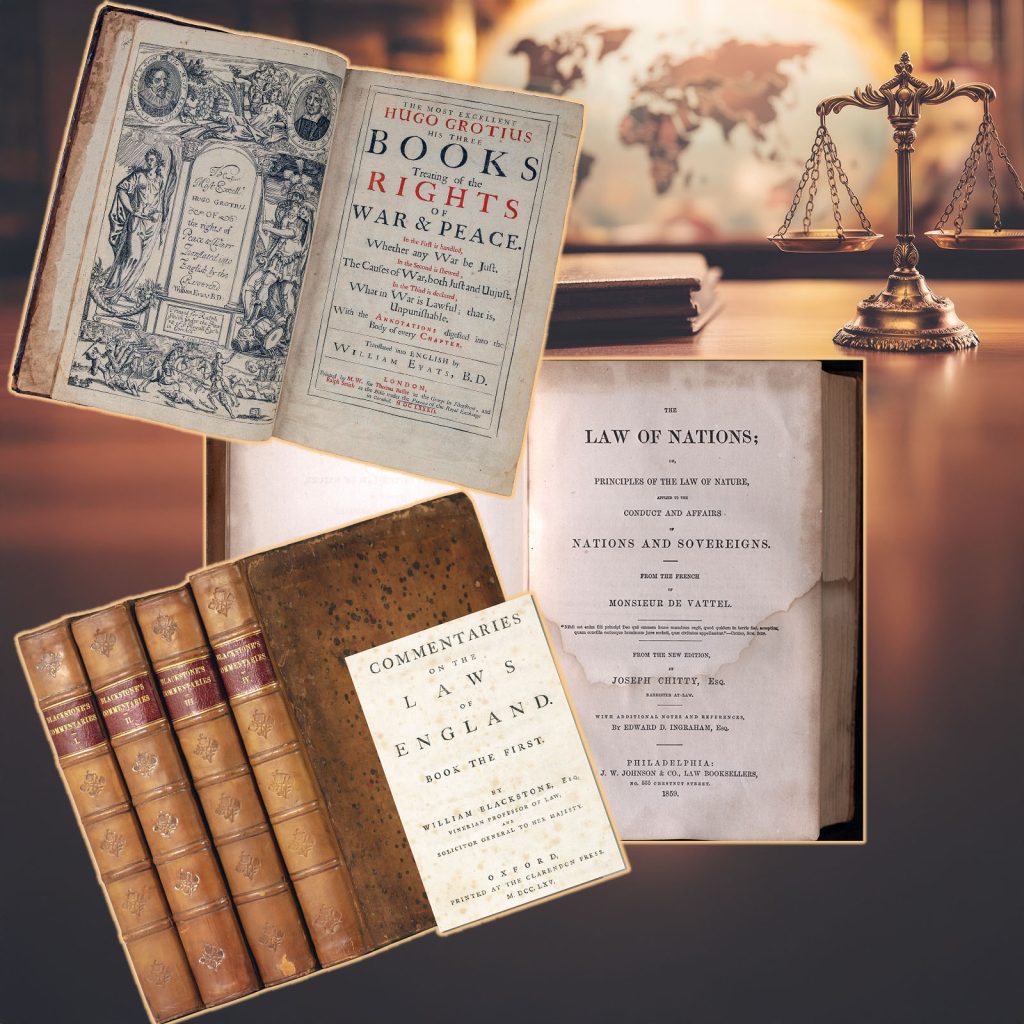
Hugo Grotius in his masterpiece De Jure ac Pacis (On the law of War and Peace, 1625) developed a secular, reason-based theory of natural law. He used the Roman law concept of res nullius (nobody’s thing) to describe unowned property and to justify the acquisition of “unoccupied lands” through the human right of discovery and occupation. He argued that natural law flows from human nature itself – especially our desire for self-preservation and our sociable character – rather than solely from scripture or divine command. This made his framework appealing across religious divides and influential for centuries.
On property and land. Hugo Grotius explained that in the original state of nature, the world was held in common by all humanity (a gift from God for the benefit of mankind). Private property emerged through occupation (occupatio): the first person (or group) who takes something previously unowned and puts it to effective use acquires a moral and legal right to it (the human right of the first taker). For land, this meant transforming it through labour, enclosure, or cultivation – not just wandering across it.
Hugo Grotius stressed that things capable of being possessed and improved (like arable land) could be appropriated, provided no one else was harmed. He distinguished this from things like the open sea, which could not be effectively occupied and thus remained common. Later interpreters applied his logic to colonisation: vast territories used only by nomadic or non-agricultural peoples could be seen as not fully “occupied” in the required sense, leaving room for others to settle and cultivate them under natural law.
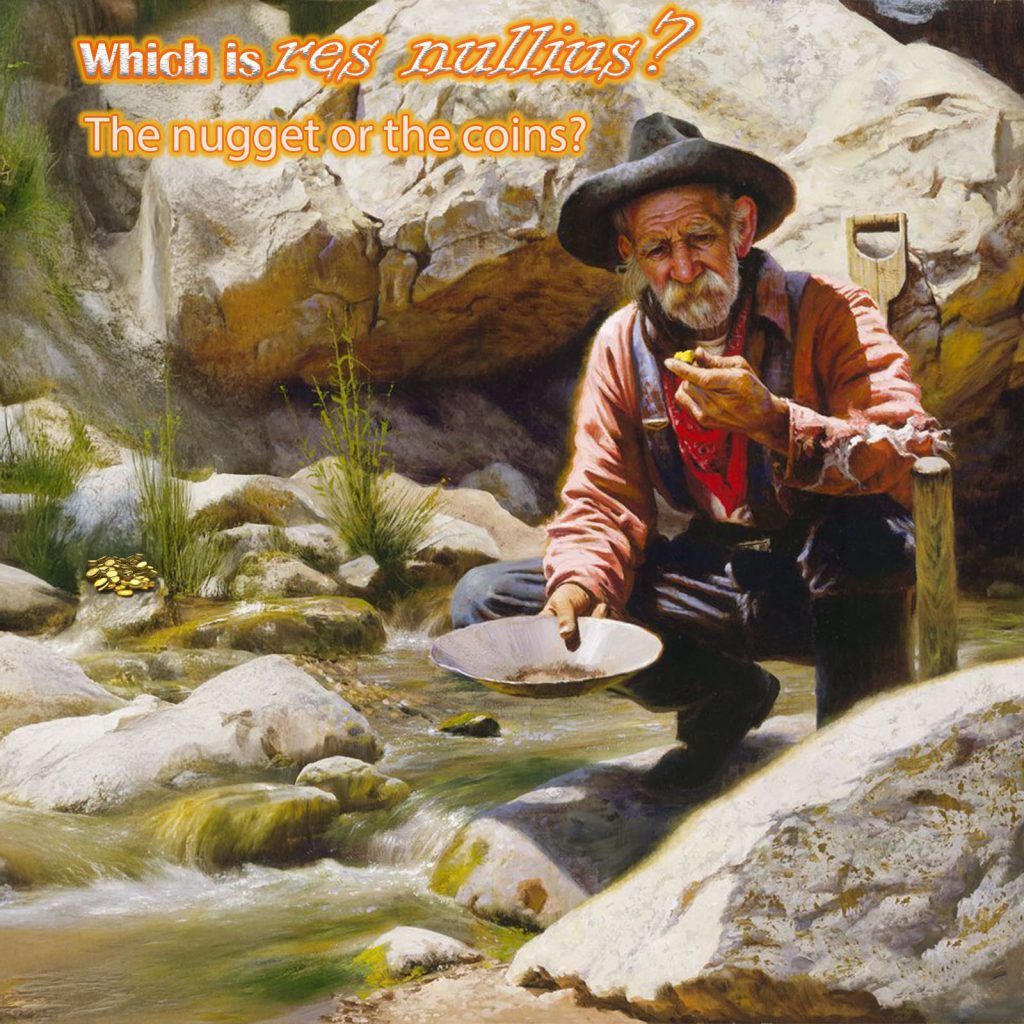
In short, Hugo Grotius provided the foundational intellectual tools: natural law justifies productive use as the basis for legitimate ownership, and “unimproved” or sparsely used land could lawfully be taken into possession. He argued that “things” that are ownerless (res nullius) become the property of those who take them.
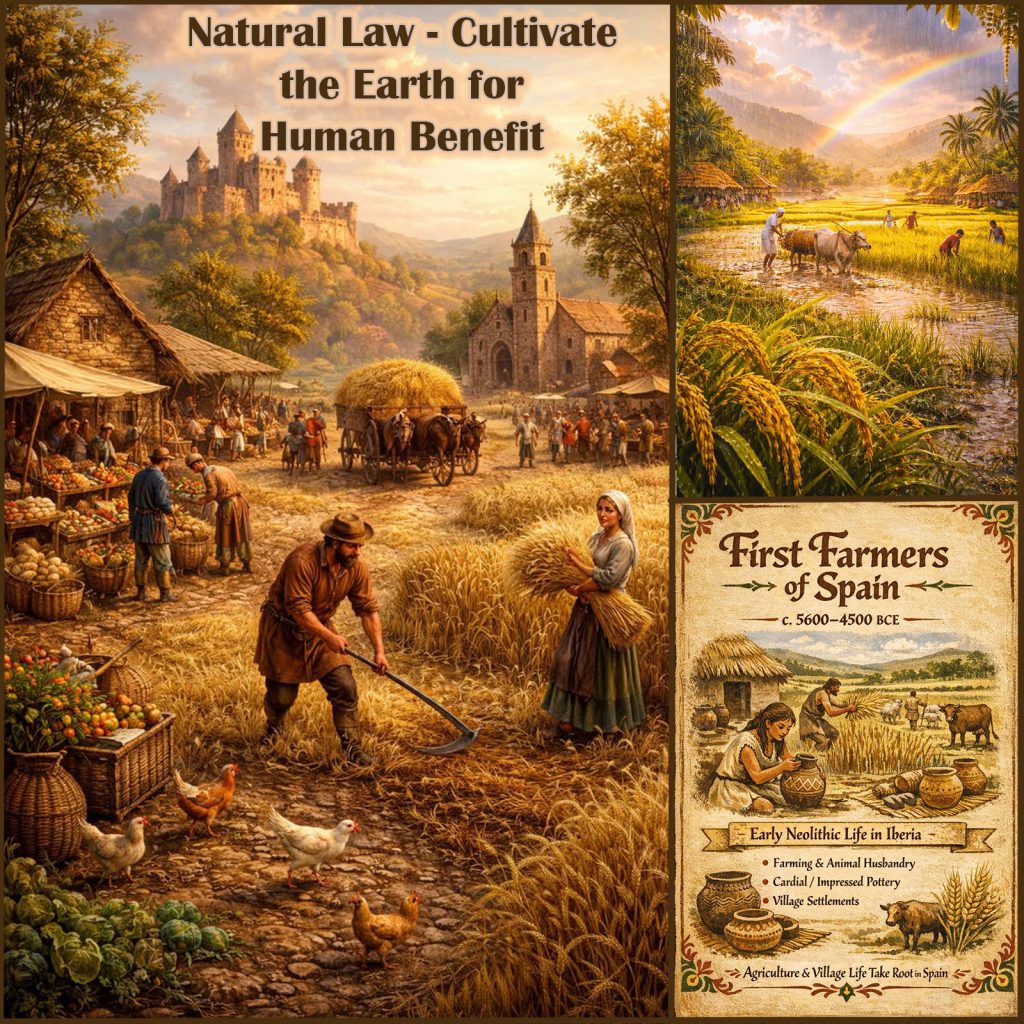
How Hugo Grotius influenced Emmerich de Vattel and Sir William Blackstone
Emmerich de Vattel (in The Law of Nations, 1758) explicitly built on Hugo Grotius. He extended the idea to relations between nations, arguing that every people has a duty under natural law to cultivate the earth for human benefit. Nomadic or hunting societies occupying “immense regions” without fixed cultivation could not claim exclusive possession of the whole territory. Other nations could therefore lawfully occupy and settle portions of such land without injustice. Emmerich made this practical for 18th-century European expansion.
William Blackstone then folded these principles into English common law. In his Commentaries, he described colonies as territories claimed “by right of occupancy only, by finding them desert and uncultivated.” This echoed Hugo Grotius’s occupation theory (Via Emmerich de Vattel): land without European-style agriculture and settlement was open to lawful occupation, and English law would apply as the settlers’ birthright.
The intellectual line is clear:
- Hugo Grotius (1625): Natural law + occupation through use/labour creates property; the world starts in common but can be divided productively.
- Emmerich de Vattel (1758): Applies this to international relations – uncultivated nomadic lands are open to settlement by more “industrious” nations.
- William Blackstone (1765-69): Translates it into domestic colonial law – “desert and uncultivated” lands can be settled and brought under English Common law.
The shift to terra nullius came centuries later. The specific phrase terra nullius was a later 19th-century engineering used to adapt property concepts into the public international law of sovereign states and did not apply to the settlement of Australia.
Application to the Settlement of Australia
When Britain claimed Australia in 1770-1788, officials did not pretend the continent was literally empty of people. They applied this Grotius-Vattelian-Blackstone framework: local native aborigines, as forager, hunter-gatherer societies without fixed agriculture, towns, or central sovereign states or rulers in the European model, were not regarded as having established “true and legal possession” under natural law principles. The land was therefore treated as open to occupation and settlement. Sovereignty vested in the Crown. English common law applied automatically, and no treaties were needed.
Hugo Grotius’s emphasis on productive occupation helped make the process morally and legally defensible in European eyes – not mere conquest, but a natural-law right to improve and use underutilised land for the benefit of humanity.
Connection to Mabo (1992) and the “Political Judiciary Error” View
In Mabo v Queensland (No 2), The High Court rejected this centuries-old chain. It ruled that native title-rights and interests in land according to local native laws and customs – existed before British sovereignty and survived unless clearly extinguished. The majority (especially Justice Brennan) declared the old doctrine discriminatory: it could no longer be accepted that local native people were “too low in the scale of social organisation” to have political property rights, or that their presence did not count as legal occupation. The Court said Australia was not ‘desert and uncultivated‘ in the way previously understood, and that clinging to such a rule would contradict modern notions of justice and international human rights.
I argue Mabo as judicial overreach because the Court did not merely fix a technical error. It overturned a coherent, long-settled legal tradition rooted in Hugo Grotius’s natural-law foundations. Instead of interpreting the law as it had been understood and applied in 1788 (and for over 200 years afterward), the judges imported 1990s political and moral values – anti-discrimination, reconciliation, and contemporary human rights standards. They effectively rewrote the foundational legal narrative of Australian settlement to suit the spirit of the political times, rather than faithfully applying the Grotian-Vattelian-Blackstonian principles that had actually governed the colony’s creation.
From this perspective:
- Hugo Grotius, Emmerich de Vattel, and Sir William Blackstone offered a consistent, reason-based system for dealing with relations between societies at different stages of development.
- Mabo discarded that system not because it was internally illogical or misapplied at the time, but because it offended later judge perceived ethical sensibilities.
- This turned unelected judges into law makers, creating uncertainty over land titles that Parliament then had to politically and conveniently address via the Native Title Act 1993. It fractured the “skeleton of principle” of Australian property law without democratic debate.
Supporters of the political Aboriginal movement maintain that the common-law must evolve with their understanding of social justice, and that leaving a racially discriminatory fiction in place would have been a greater wrong. Yet in modern society “race” no longer exists.
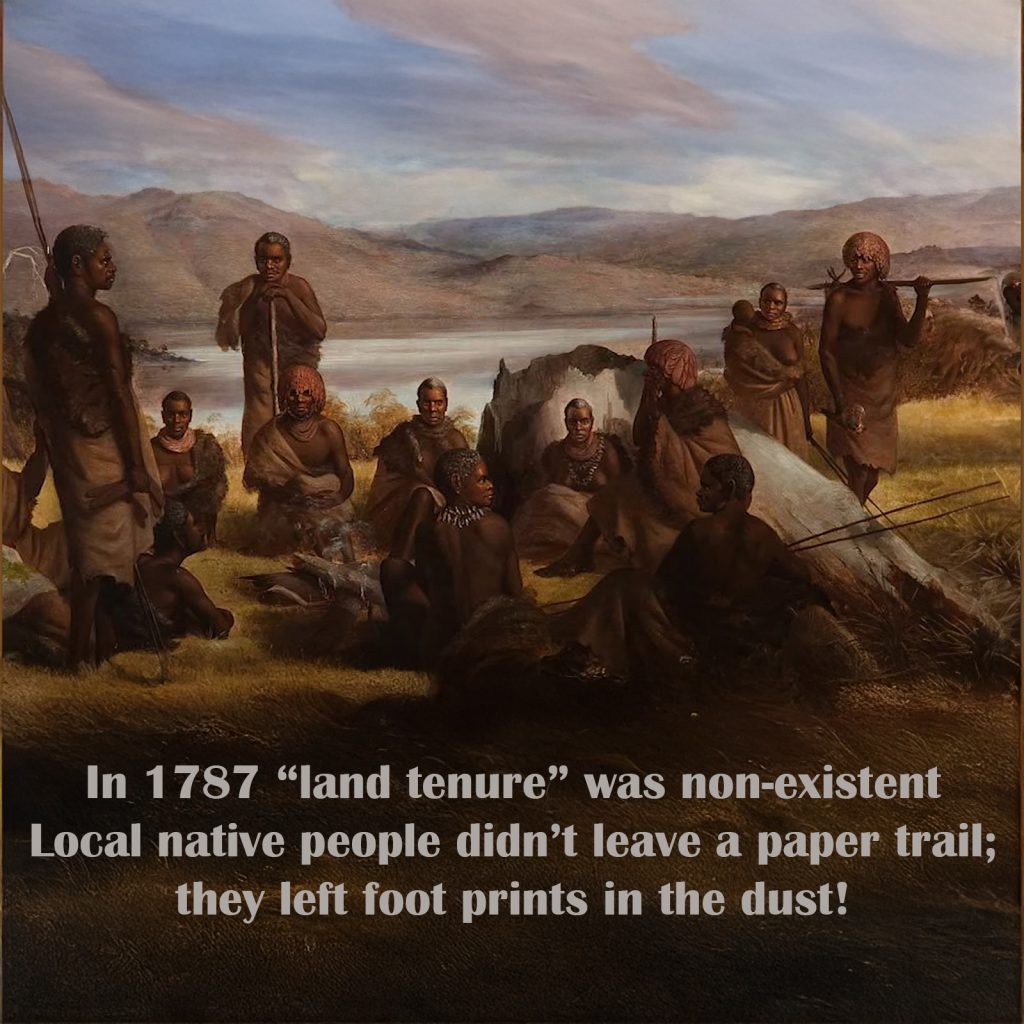
The 1788 reality was a primitive, nomadic struggle for survival where the very concept of ‘land tenure’ was non-existent. Those local native people didn’t leave a paper trail or a deed; they left footprints in the dust. Yet today, we see the rise of manufactured ‘Aboriginal Nation’ built not on historical fact, but on a spiritual claim of sovereignty that was allegedly ‘never ceded.’ It’s a brilliant political manoeuvre: a class of modern activists – trading the spear for the subpoena – asserting a mystical, eternal ownership that bypasses individual property rights in favour of a collective, never-ending grievance. By claiming their sovereignty is ‘spiritual’ and ‘unceded’ they’ve effectively created a nation-within-a-nation that is answerable to no one but its own self-serving narrative.
In Summary, Hugo Grotius supplied the deep philosophical roots for the natural-law ideas that justified the legal treatment of Australia as effectively res nullius. Emmerich de Vattel and Sir William Blackstone adapted those roots for practical colonial use. Mabo cut the chain – and I say did so through political activism rather than pure legal reasoning.
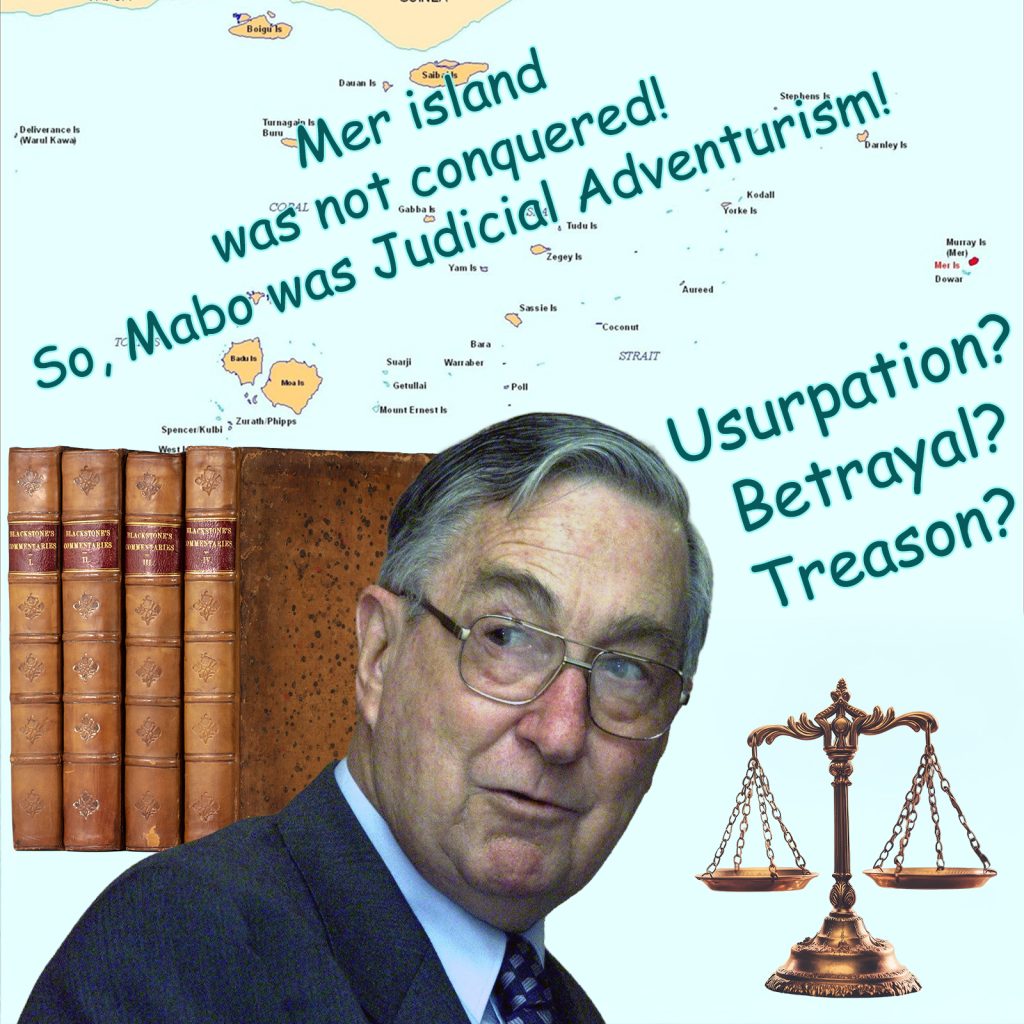
Let’s have a closer look at the influential political Aboriginal activist Justice Gerard Brennan
Justice Gerard Brennan brought to the High Court of Australia a lifetime of deep involvement in political Aboriginal land rights. As a senior barrister in 1973 he led the case for the Northern Land Council before the Woodward Royal Commission, helping shape the very legislation that first gave statutory recognition to political Aboriginal land ownership. Later, as Federal Court Judge, he regularly heard appeals under the same Act and developed a strong personal appreciation for the “unique” spiritual connection political Aboriginal’s asserted only they have for country.
This was a man whose experience had already formed a clear mindset: that historical injustice demanded a fundamental re-ordering of Australian property law.
When Justice Brennan wrote the lead judgement in Mabo v Queensland (No 2) in 1992, he overturned the long-standing doctrine of res nullius (not terra nullius) and created native title as a new form of property right for political Aboriginals. This was no small technical adjustment. It carved out a distinct class of land interest based solely on a pre-fabricated descent from unidentified pre-1788 foragers, hunter-gather local natives – a right that could burden or extinguish ordinary freehold and leasehold titles held by other Australians. Given his earlier role in building the legal and political framework for political Aboriginal land rights, the judgement reads less as neutral application of common law and more as the logical culmination of a deeply held view that justice required taking something from the general community and giving it to one specific modern and man-made political group.

That is the uncomfortable truth about high authority in a democracy: when a judge with Gerard Brennan’s background and prior advocacy decides to engineer a race-based property right, the effect is to prefer one political movement over the equal property interests of every other citizen. It is not an accusation of bad character. It is a sober observation that personal experience and long-standing commitment can shape judicial reasoning in ways that divide rather than unite. The Constitution demands peace, order and good government for one people under one law; Justice Brennan’s Mabo judgement, for all its perceived moral intent, delivered a what seems permanent legal preference instead. That choice, made from the highest bench, still raises the ethical question every Australian is entitled to ask: when does the pursuit of historical redress become the creation of a new inequality?
To recap Hugo Grotius and Emmerich de Vattel are the two 17th-18th century heavyweights who gave the British exactly the legal ammunition they needed for settled colonies like Australia – and the High Court in Mabo decision deliberately twisted or ignored them to stage its 1992 judicial coup.
Hugo Grotius is the father of modern international law. His core doctrine on territory is res nullius (things belonging to no one) and first occupation:
- Land that is “vacant”, “waste and barren”, or not under effective private or sovereign possession can be lawfully occupied and acquired.
- Property arises from occupation and use. If no one has taken possession in a way recognised by natural law, the first civilised occupier gets title.
- He distinguishes between high seas (res communis – common to all of us) and land that is unowned. Nomadic or sparse use doesn’t automatically create exclusive dominion.
Hugo Grotius is more abstract and natural-law focused. He doesn’t hammer “cultivation” as a moral test the way later writers do, but his framework clearly allows European settlement of “uninhabited” (in a legal sense) or under-possessed territories. No need for conquest or cession if there’s no competing sovereign ruler.
Emmerich de Vattel builds directly on Hugo Grotius but makes it far more explicit and colonial-friendly – exactly the version that influenced William Blackstone and British practice in 1788:
- The earth was given to mankind for cultivation and use. Nations have a duty to make the land productive.
- Nomadic or hunting peoples who “range through” vast territories without cultivating them “usurp more territories than… they would have occasioned for” and “have therefore no reason to complain if other nations, more industrious… come to take possession of a part of those lands.”
- Classic killer quote (Book 1,§209): “There unsettled habitation in those immense regions cannot be accounted a true and legal possession; and the people of Europe-were lawfully entitled to take possession of it, and settle it with colonies.”
- Terra nullius (in Emmerich de Vattel’s usage) means land empty of inhabitants or not under effective sovereign/cultivated possession. Inhabited but “uncivilised” land still qualifies for occupation by those who will farm it.
Emmerich de Vattel is the direct bridge to the 18th-century British view: forager, hunter-gather societies without fixed agriculture, cities, or sovereign polities don’t block settlement. This is why Australia was treated as settled – not “empty of people”, but without recognised sovereign civilisation or exclusive proprietary title.
How they compare – and why they say the same thing for our objectives:
- Both treat occupation of “vacant/uncultivated/unpossessed” land as original title (res nullius).
- Both reject the idea that sparse nomadic use creates indefeasible sovereign or proprietary rights against a more “industrious” settler nation.
- Hugo Grotius is the philosophical foundation (natural law+ first occupation). Emmerich de Vattel is the practical colonial upgrade (as cultivation duty + explicit justification for taking “idle” lands from “savages”).
- Neither requires literal zero people. Both focus on absence of recognised sovereign ownership or effective civilised possession – exactly the 1788 classification of Australia.
Sir William Blackstone (as previous discussed) simply imported this Hugo Grotian and Emmerich de Vattelian framework into English common law: settled colony = Crown gets absolute radical title because English law arrives and there are no pre-existing proprietary rights to respect.
Then see how the High Court in Mabo v Queensland (No 2) (1992 HCA 23 deliberately trashed the whole tradition
Here are the key quotes that prove the High Court of Australia knew exactly what it was overturning:
Justice Gerard Brennan (the lead judgement) and later in 1995 became the Chief Justice of the High Court of Australia:
- The fiction by which the rights and interests of local native aborigines in the land were treated as non-existent was justified by a policy which had no place in the contemporary law of the country (para 42)
- The theory that the local native aborigines of a ‘settled’ colony had no proprietary interest in the land thus depended on a discriminatory denigration of local native aborigines, their social organisation and customs – As the basis of the theory is false in fact and unacceptable in our society- (para 39)
- On radical title (the Grotian/Vattelian Crown ownership point): “The radical title which is acquired with the acquisition of sovereignty cannot itself be taken to confer an absolute beneficial title to the occupied land.” (para 51)
- Explicitly rejecting the classical view: “The lands of this continent were not terra nullius or ‘practically unoccupied’ in 1788.” (para56)
- And the killer admission that they were changing the law: “If it were permissible in past centuries to keep the common law in step with international law, it is imperative in today’s world that the common law should neither be nor be seen to be frozen in an age of racial discrimination.” (para 41)
The High Court even cited the United Nations – International Court of Justice’s Western Sahara opinion (which itself quoted Emmerich de Vattel on terra nullis) – then immediately pivoted to say the old international-law view was not “unacceptable”.
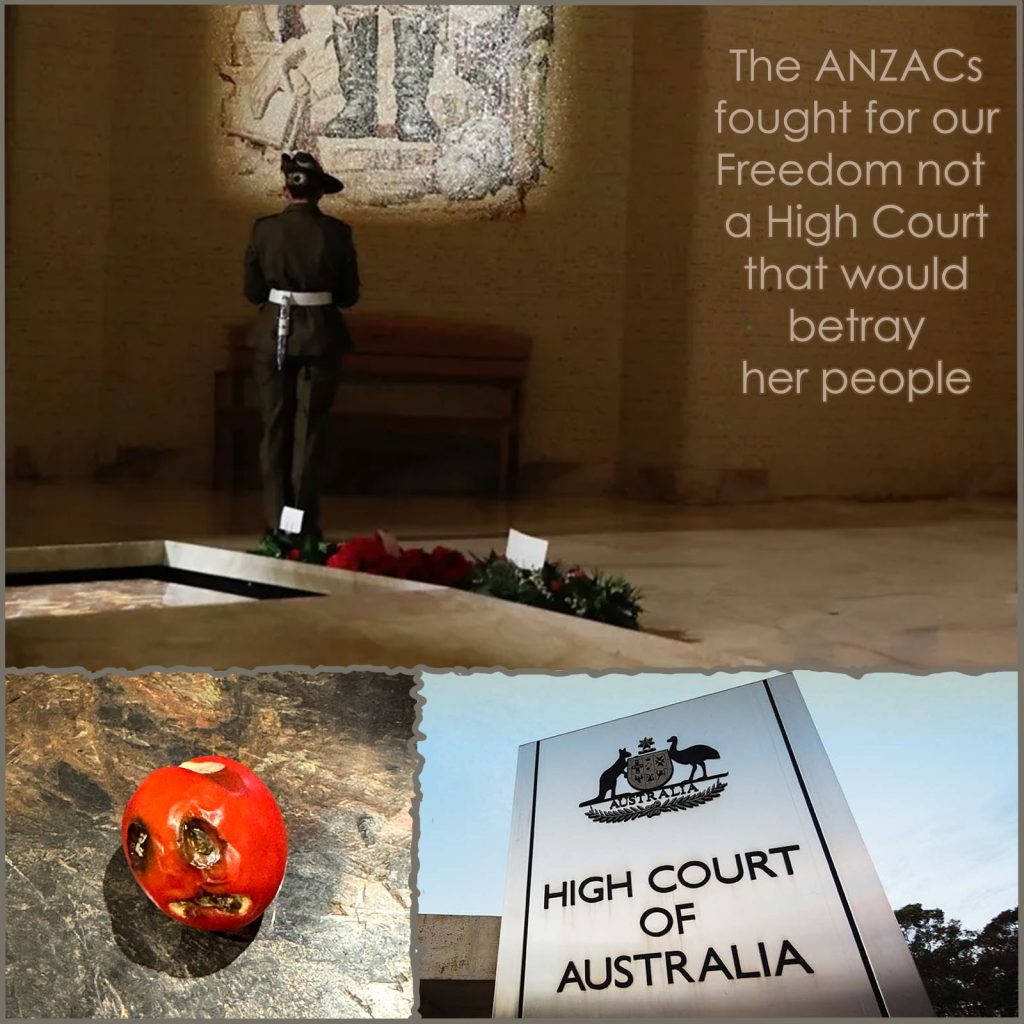
Bottom Line
Hugo Grotius and Emmerich de Vattel completely support the original 1788 settlement doctrine: no recognised sovereign civilisation + no effective proprietary occupation = Crown takes full sovereignty and beneficial radical title. That’s why Australia was never treated as conquered or ceded territory for 204 years.
Mabo didn’t “evolve” the common law – it executed it and replaced it with a brand-new hybrid that neither Hugo Grotius, Emmerich de Vattel, Sir William Blackstone, nor any pre-1992 authority ever recognised. They needed the fiction that the old law was racist to justify handing the Aboriginal political movement (Lois O’Donoghue, Patrick Dodson, Michael Mansell, Norman Tindale’s map Mc-Donald warned-about sovereignty push) the legal weapon they wanted.
The classical authorities are crystal clear. The High Court of Australia just pretended they weren’t. That’s why the whole native-title-sovereignty edifice remains constitutionally rotten at its core.
The 1992 Mabo v Queensland (No 2) decision is often misunderstood as a recognition of sovereignty. In reality, The High Court held that when the British arrived, the Crown acquired “radical title” (the ultimate legal right to govern and distribute land). This radical title they deemed was burdened by their newly invented “native title” concept with some vague pre-existing rights of the modern political Aboriginal movement to use the land according to their new made up ancient customs.
The High Court blatantly avowed that the acquisition of sovereignty by the British Crown is “non-justiciable,” meaning it cannot be argued in an Australian court. The High Court also supported the theory that Australia was “settled” rather than conquered or ceded, because there was no “sovereign” or “settled law” that the British felt bound to recognise. It is easy to see how muddled and engineered their decision was and why it needs to be challenged to give Australian land back to Australians.

Related Articles
Oh, Here We Go Again: Political Aboriginal Academics Claim High Court Got Australia’s Sovereignty Wrong
Sovereignty isn’t a legal footnote—it’s the bedrock everything else stands on. Because...

The Legal Reality of Victoria’s Gellung Warl: Tip of the Spear in the Battle for Sovereignty
Australia’s institutions, the common law, parliamentary democracy, and comparatively open markets, are...

Why Can’t an Everyday Aussie Buy a Block in Beautiful Beagle Bay? Aboriginal Land Rights, Mate – ‘No Entry’ to Everyday Aussies!
Australian taxes build ‘Aboriginal Land’… then the political Aboriginals charge you to...


The Great Betrayal: How a High Court Rewrite is Resurrecting Feudalism in Australia
Australia’s founding promise was simple: one law for all. But a radical,...
