

Polio is a good example to explain the difference between sickness and ‘disability’ – Remembering Paul Richard Alexander
 Maria Rigoni01/05/202510 Mins read
This is an updated version of an article I authored in 2023.
At various times during the first half of the 20th century, with an upsurge in cases each summer, Poliomyelitis, commonly called polio struck randomly. Polio is a virus that spreads indiscriminately from human to human. A virus that socked individuals without warning and who once infected had no treatment besides time and tending to the symptoms.
With similar numbers to the COVID19 virus, in about 98% of infected cases, polio was a mild illness, with no or with typically flu-like symptoms. In paralytic polio, the virus left the digestive tract, entered the bloodstream, and then attacked nerve cells. Fewer than 1%-2% of people who contracted polio became paralysed. There was no way of predicting who would walk away from the infection with nothing more than a headache, and who would never walk again. In austere cases, the throat and chest muscles were paralysed. Death did result quickly if these patients did not receive artificial breathing support.
During the late 1930’s and early 1940’ and 1950’s major outbreaks of polio caused much heartache and body destruction. No country around the world was safe from its epidemic clutches. The fear of lifelong paralysis was worse than the threat of dying. The virus prized children the most and was referred to as infantile paralysis as more than 50% of people infected were children under the age of seven years.
Polio is not the only disease that causes permanent human body damage. The consequence in the daily life of those affected is a good example to explain the difference between sickness and ‘disability’ as often chatted about.
My husband Antonio Giovanni Rigoni contract polio on Christmas Eve in 1954 when he was 6 and a half years old. He had paraplegia as a result because polio stripped him of all the muscles in his legs and feet and those on his left hip. He lived in his body with broken parts for a further 65 years.
Unlike Paul Richard Alexander Tony’s respiratory system was not affected.
Here are some facts and thoughts in relation to Paul Alexander and his life on Earth.
Paul Alexander believed he lived an incredibly beautiful life. Paul lived in an iron lung for 72 of the 78 years he was alive. Paul answered the phone and typed using a plastic wand attached to his mouth. Man-made freedom giving equipment.
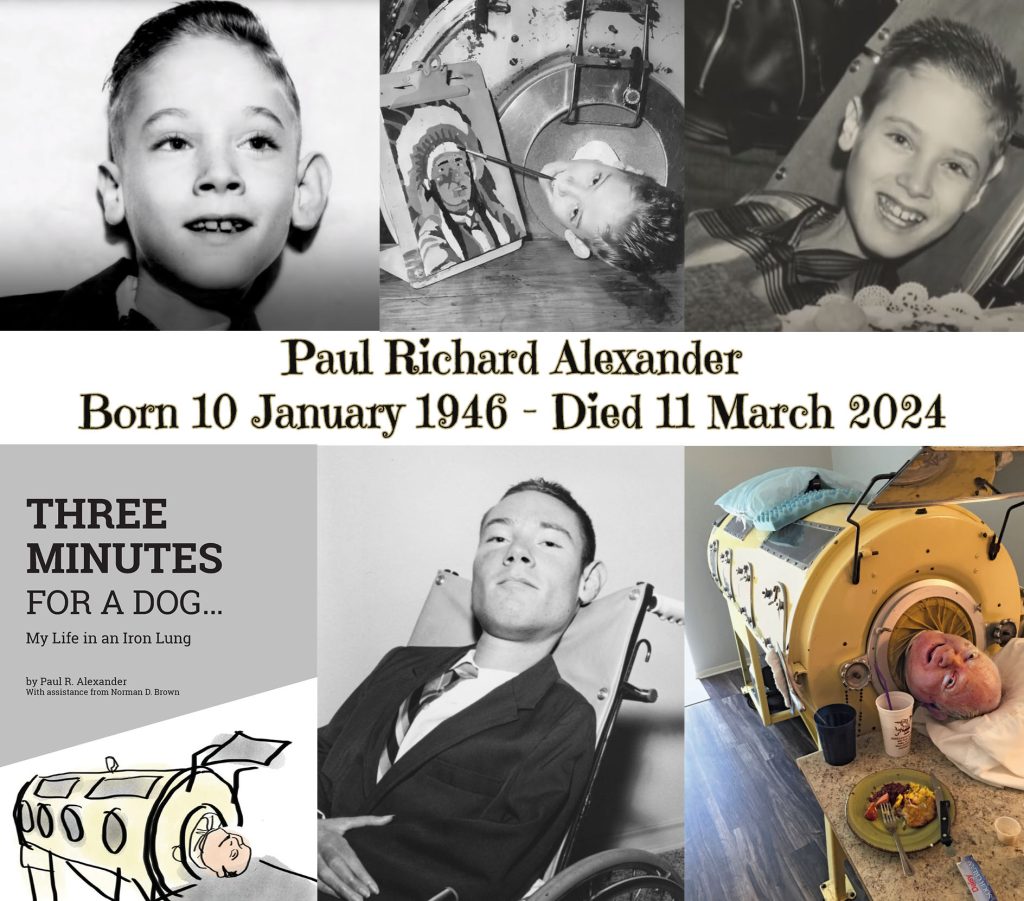
Born in Dallas, Texas, in the United States of America, Paul, until his younger brother was born many years after him, was the only blonde-haired, blue-eyed person in the dark-haired, brown-eyed Greek and Lebanese ancestral family.
In 1952, when he was six years old, Paul was infected with the poliomyelitis virus. Until then he was just a happy go lucky kid like everybody else his age. While playing outside in the summer rain and mud he started to feel unwell. With a thumping head, stiff neck, and abandoned shoes, he went inside to the kitchen where his mother looked at his feverish face and gasped “Oh my God! Not my little boy!”. His mother immediately sensed and knew the cause and cried, “Come on God, not my child!”.
Paul was sent to have a bath, then ordered to bed. The hospitals were overflowing with children with polio and not a place to immediately go to. The doctor was called, and the diagnosis of polio was confirmed.
Over the next few days, Paul lost all body function, he could no longer move, walk, hold a spoon, speak, swallow or cough. On day five his diaphragm failed, and he could not breathe properly. His parents then rushed him to the hospital, and waited in the children’s polio ward. There were sick children all over the place. Paul’s mother held him in her arms as the doctor told her that there was nothing that could be done for him. Paul was expected to quietly die, quickly.
Then when very close to death, barely breathing Paul was lying on a hospital trolley when another doctor passing by looked at him and decided to examined him again. It was not Paul’s time to die, he had a long life to live. That doctor decided to perform an emergency tracheotomy to suction the congestion in his lungs that his paralysed body could not shift. This allowed air to flow into his lungs.
Three days later Paul woke up still unable to speak, swallow, move or cough. His motionless body was sheathed in a wheeze and sigh machine, his head was shrouded by a plastic steam tent. Most of the work of his breathing was previously done by his diaphragm now the iron lung was a must to rouse each breath by varying the air pressure to compress and depress his chest. Negative pressure was the required implement.
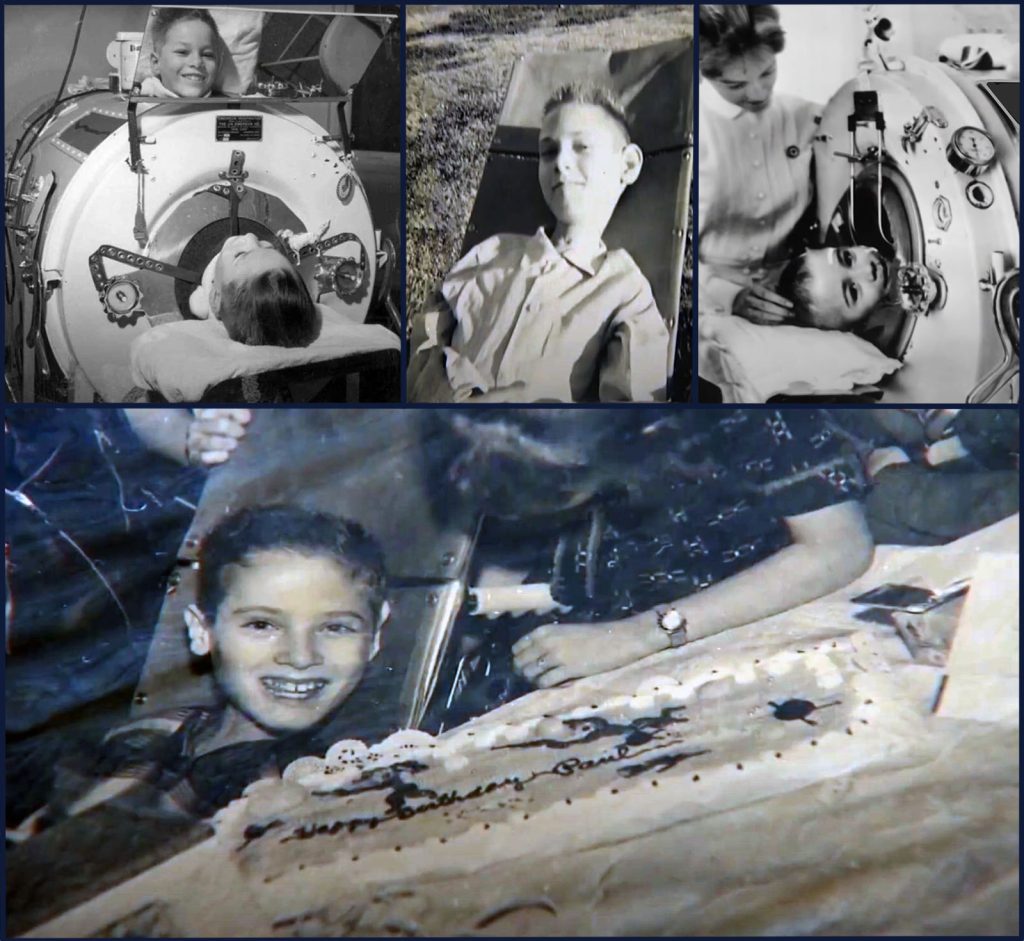
The iron lung, whirring and puffing, chugging and swish swishing, helped preserve his life. The tent produced a consistent flow of steam to maintain fluidity of the mucus for ease of removal.
As far as he could see, there were rows and rows of children’s heads with their bodies hidden in the same type of metal canister as he lay in. The children could not see their bodies or touch their own faces. If a child had an itch on their nose they could not scratch it. Not being able to breathe on their own terrified them and some children cried out in pain.
A polio patient with a paralysed diaphragm would typically spend two weeks to many months inside an iron lung while recovering. Many did not recover. Few survivors where left in Paul’s ward.
Paul recovered from the initial infection however the encounter with polio left him paralysed from the neck down and fearful of doctors and nurses. The iron lung did what his diaphragm was no longer able to do for him. Breathe. His lungs were expanded with air and then deflated to a set rhythm. On occasions he nearly drowned in his own mucus and he listened to the doctors talking daily about their expectation he was about to die or how he should not be alive.
Paul felt angry and kept flouting the doctors’ expectations. His spirit of defiance grew stronger. He was frustrated by the medical disregard for his survival and the months of periodic itching and skin burning from lying in his own waste unattended for hours at a time while unable to move.
After Paul was admitted to hospital, eighteen torturous and boring months passed before doctors said he could go home. The medical staff genuinely believed he would not be alive for much longer. On the back of a rented truck, encased in his iron lung powered by a portable generator, just because they loved him, his mum and dad brought him home for Christmas. On the day he arrived home he gobbled up, swallowing in rhythm with his breathing machine, a plate full of the best tasting SPAM a brother had cooked for him.
Paul’s parents set up his iron lung in the living room and they slept in the same room. Always half-asleep listening just in case the swish-hiss of his machine stopped due to a power cut when they would need to hand pump the machine until the electricity came back on.
There was a mirror in front of Paul so that he could see what was going on behind him. There was a frame where a book or a newspaper could be placed, but if someone was not around to turn the pages there was not much point really. His father invented many unique tools and adapted elements in his environment to provide a better life. Really his father did all he did just to make Paul more comfortable.
“My parents taught me to use my intelligence and energy to be productive. I’ve always been a curious person. I’ve never thought of my self as disabled.”
Using Paul’s own words to describe his initial polio situation he said. “Within a week I had lost all my movement. Within a week I couldn’t shallow and I could stop breathing. I thought I was in hell! I couldn’t talk, I couldn’t move, I couldn’t breathe, I couldn’t scratch! All I saw was a big room of iron lungs. It was so confusing. Why did the children die? Why didn’t they stay alive? Why did I stay alive?”
He asked God why did you take them I was making friends. They died and he asked God “how come I didn’t die. Why didn’t I die? Come on what is the deal? Why didn’t you let me die? He never answered me. I just kept living.” God did not want Paul to die then.
All through his life Paul had an unquestionable faith in God, he believed that god blessed him with some very caring, very loving and very competent people and he was most thankful what he had done and this gave him a will to do his best in life and to see what he could do in the next move of his next challenge.
Grief was Paul’s rite of passage to a new way of living and learning. What was normal was doing what he could. With the promise of a puppy and the help of a therapist Paul soon learnt a breathing technique called “glossopharyngeal breathing”. Frog breathing. A skill that used muscles in his mouth and throat to gulp air into his lungs. A technique that allowed Paul to overcome his fear of being outside his iron lung.
This was his turning point. Paul decided to take the road to his new future – a life of relative independence.
By using his “frog breathing” muscle memory skill he eventually could breathe outside his metal cocoon for extended periods of time each day. Freedom from full-time life in the iron lung. First he ventured out on to the porch, then into the yard, then friends would push him around the streets. Paul learned how to read, paint, and write with a paintbrush or pencil in his mouth and Paul used his mind to memorise instead of relying on taking notes.
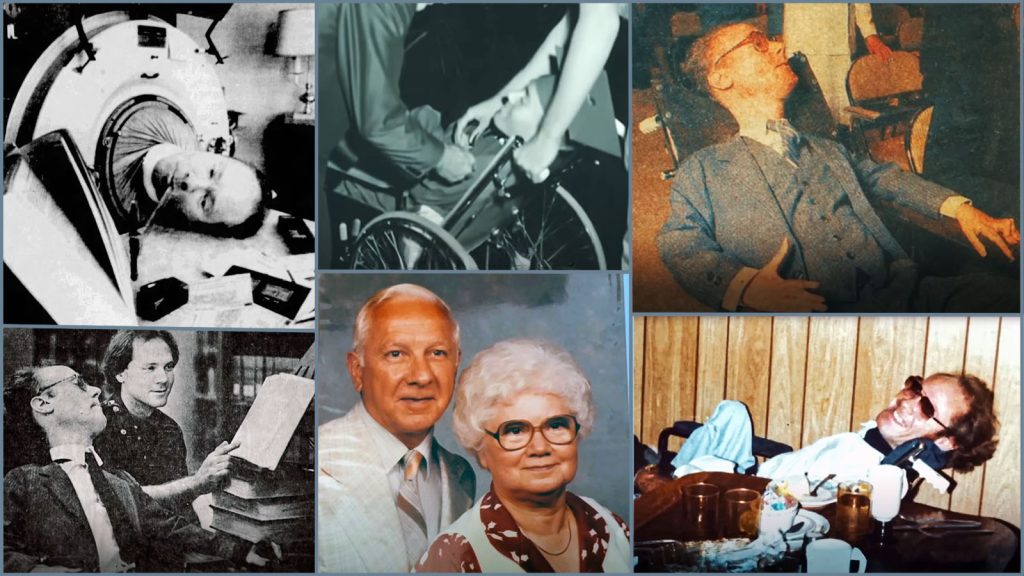
Home-schooled he graduated second in his high school class, then he attended law school, passed the bar exam, and started his own law practice. As a family and bankruptcy lawyer the decades passed while he represented his clients in court. Paul earned good money for himself and employed a secretary to help him manage his clients. He had an iron lung in his office. In his three-piece suit and tie he would attend court to represent his clients and to assist his mobility he used a modified wheelchair that held his paralysed body upright.
Paul was not sick he was paralysed. Being glaringly impeded by paralysis is an alternative way of living.
Paul never thought of himself as a cripple. “I’ve never thought of myself as a cripple. That’s the word I choose to use, because I think it covers the ground in most people’s perception”. He has said he was not disabled, not handicapped, or not limited. He was crippled at least in most people’s mind but not in his mind. Paul recognised that his iron lung was part of him.
Everyone was petrified by the concept of polio. The iron lung didn’t stop Paul from living a full and long life.
Through the years Paul travelled on planes, attended church, went to clubs, restaurants, and strip bars, cinemas, and enjoyed ocean views, he fell in love, and lived alone. He was visible in the community and needed to be so people could gain a different perspective of living a different yet ordinary normal life.
Paul thought he would marry but the parents of his would-be bride stopped her from seeing him any more as her parents had a different view of how of love and marriage should be.
Paul had a difficult life. It was tough. He grew to a height of just on five feet tall. He had been abandoned by attendants and even been extremely sick on occasions. He had the government deny him fund his care. Living life offered him many challenges and he wrote and self published a book to tell people how he refused to be limited by the body damage polio bestowed upon him.
In 2023, Paul as a 77-year-old lived alone in a spacious apartment in Dallas, Texas in the USA. Paul was attended by a staff of around the clock guardians. One attendant, Kathryn, was with him for 30 years. Towards the end of his life he lived 24 hours a day in his hiss and sigh, canary yellow, refurbished antique breathing machine.
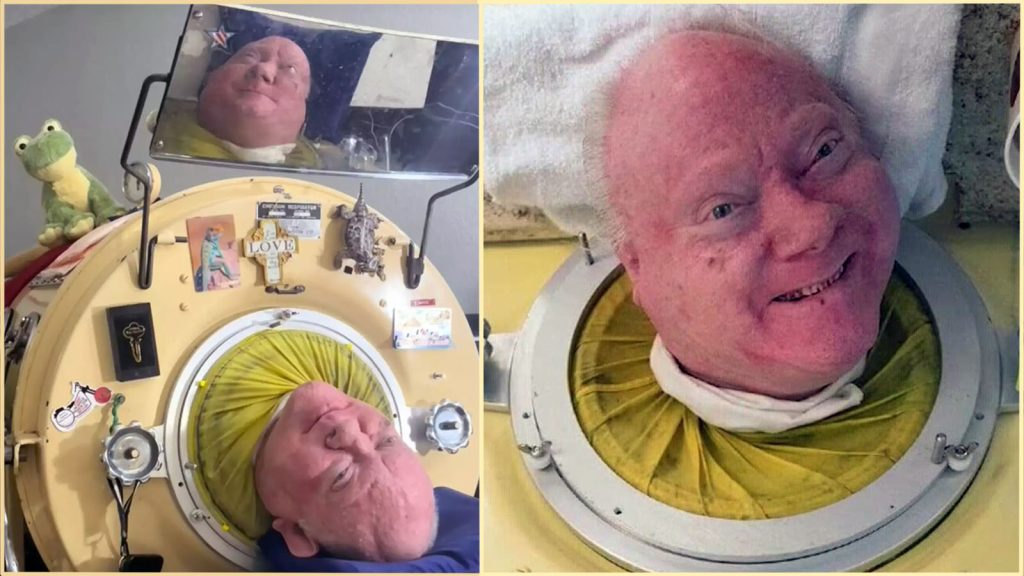
Without being able to paddle his own canoe Paul’s life not only depended on his iron lung not blowing a gasket and the electricity remaining on, staying alive was 100% reliant on other human beings being with him to keep an eye on and satisfy his basic human needs.
In Australia Paul would not qualify for the National Disability Insurance Scheme as he was not considered ‘disabled’ he was considered ‘aged’.
Not many people can get their head around Paul’s way of life had nothing to do with being sick or being ‘disabled’ by society. It is not that he never got sick, sickness was not part of his daily routine. He never applied or asked for a job to prove society understood diversity. Paul understood he did not have to overcome his physical limitations, he had to live life with them as they were part of him.
Being paralysed and requiring a respirator is not a barrier to living a rich life full of adventure and achievement. Not having access to freedom giving equipment is. Freedom giving equipment not only enhances people’s quality of life it changes people’s perceptions and stimulates innovation.
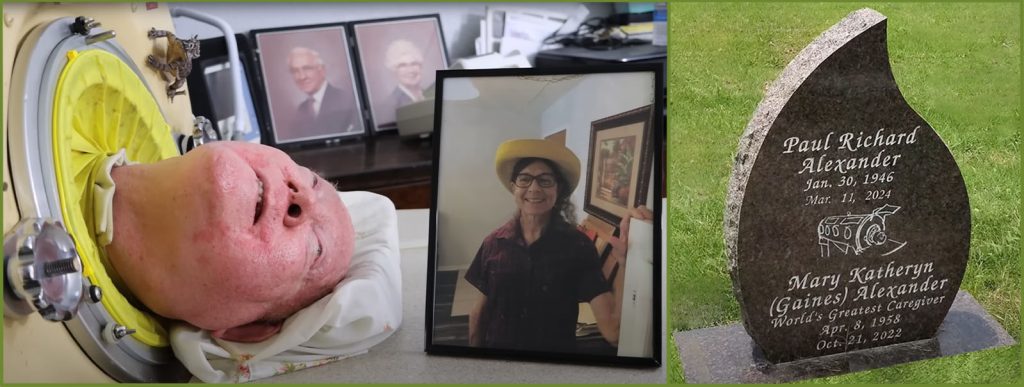
Of his long term carer, Kathryn, he reflected “This is my baby. She took care of me and I took care of her. An amazing lady. She was a gift from God!”
Freedom giving equipment is but one part of the story. Breathing is vital for human existence. There are multiple devices available to support breathing for people with high spinal cord injuries and quadriplegia. The level of physician knowledge, engineering ingenuity, the injured person’s preferences, financial capacity, and specific needs determine what approach is used.
The iron lung uses negative pressure. It creates a vacuum around the body, forcing the ribs, and therefore the lungs, to expand; air then rushes into the trachea and lungs to fill the void. The iron lung is an old approach that saved many people’s lives however is rarely used today. A hand pump ventilator is required to be used as a backup if the mechanics fail.
A mechanical ventilator powered by electricity or batteries blows air directly into the lungs to make them expand, and then allows the body to passively relax and exhale. A tracheotomy maybe required: an incision in the neck, through which a tube goes into the windpipe and delivers oxygen to the lungs. A hand pump ventilator is required to be used as a backup if the mechanics fail.
Considered safe and durable, in 2020, about 2,000 patients worldwide had a diaphragm pacing device. A diaphragm pacing system is a battery-powered system that electrically stimulates a persons’ diaphragm muscles and nerves. This causes the diaphragm to contract so that air is pulled into the lungs in a more normal way. A diaphragm simulator maybe more comfortable, allow increased mobility, protect from upper respiratory infections and is much quieter than a mechanical ventilator. A tracheotomy may not be necessary and many patients with these implants are completely weaned from a mechanical ventilator.
All three-man-made inventions are freedom giving equipment and lifeline choice for people who have paralysis from the neck down.
Final words from Paul, “We are human beings too! We have something broken and want to operate in a day to day environment just like you!”



Related Articles

Feel love, show love, share love of time and life
Once upon a heaven’s day Love came to me with tears of...

‘Aboriginal Race’ fruitful hunter treaty is a demand on Australian taxpayers money
The ‘fruitful native hunter’ on his reappearance at camp had to share...
British settlement is guilty of giving all Australians citizenship power
British settlement is guilty of giving all Australians a legal citizenship power,...


Blackfella Maria Lock married a whitefella, a convict, who the government assigned to her
Although the actual date will never be known in around 1805 at...
